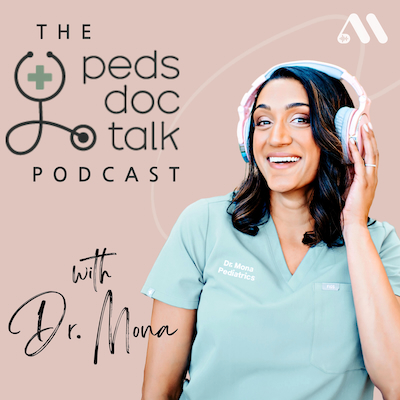

A podcast for parents regarding the health and wellness of their children.
On this episode, I welcome Dr. Tim Schrader, the medical director of the Hip Program at Children’s Healthcare of Atlanta, to discuss Hip Dysplasia.
We discuss the following (and so much more):
00;00;08;27 – 00;00;23;29
Dr. Mona
Welcome to this week’s episode. I am so excited to welcome Doctor Tim Schrader. He is the medical director of the Hit program at Children’s Health Care of Atlanta, and we are going to be talking all about hip dysplasia today. Thank you so much for joining us, Doctor Schrader.
00;00;24;01 – 00;00;25;23
Dr. Tim Schrader
Hi. Thank you for having me.
00;00;25;25 – 00;00;44;12
Dr. Mona
I’m really excited that you were able to join us. Hip dysplasia is actually something I obviously think is really important, but not a lot of parents know about it until their child is diagnosed with it. So I’ve been getting a lot of questions from my social media following. I take care of patients myself with hip dysplasia, so I’m really happy you could join us today.
00;00;44;19 – 00;00;45;07
Dr. Tim Schrader
Great.
00;00;45;09 – 00;00;51;15
Dr. Mona
So first of all, I wanted to talk about what exactly is hip dysplasia. What does that mean and how common is it?
00;00;51;18 – 00;01;17;21
Dr. Tim Schrader
Hip dysplasia is any abnormality between the femoral head and the acetabulum, or that the ball and the socket part of the hip joint? It’s really a catch phrase. It’s said there’s a continuum. There are very mild forms of hip dysplasia where on X-ray or ultrasound or by MRI there’s some structural abnormalities, but nothing can be detected on physical examination.
00;01;17;21 – 00;01;38;20
Dr. Tim Schrader
There’s the hip is not dislocated. And then it can go all the way through to hips that are loose or unstable or dislocated, where you can physically feel the hip slipping in and out of socket. And the other question about how common it is really depends on how you define it. So some of these really subtle things are very common in newborns.
00;01;39;17 – 00;02;03;19
Dr. Tim Schrader
You know, 1 in 10 newborns may have some hip looseness after they’re born, with 90% of that resolving on its own very quickly. If you use an ultrasound in the nursery to diagnose hip dysplasia, the incidences is quite high. I think most pediatric orthopedic surgeons would tell you the incidence of true hip dysplasia that would benefit from treatment is is about 1 in 1000 births.
00;02;03;21 – 00;02;08;04
Dr. Mona
Okay. And are there certain risk factors for the hip dysplasia that does need treatment.
00;02;08;15 – 00;02;38;18
Dr. Tim Schrader
Yes. There are certainly risk factors for hip dysplasia. The more common ones that, yeah, we typically learn about during, medical school and training are breech positioning, being a first born, and females and having had a immediate family member, parent or sibling with hip dysplasia as well. So the family history, there’s also some other more recent things that have come up, particularly swaddling.
00;02;38;18 – 00;03;02;15
Dr. Tim Schrader
So if we can recreate a tight intrauterine environment after birth, we can create the same risks, that are there and actually can cause hip dysplasia to develop or take hips that may have responded on their own and gotten better without any formal treatment, and push them over the edge to where they became true hip dysplasia that actually does need treatment.
00;03;02;25 – 00;03;15;28
Dr. Mona
So glad we’re talking about this, because that is one of the questions I commonly get. So is there just a certain thing that parents need to be watching out for when they swaddle their babies? Or do you think that swaddling is just too risky for the hips? Or what would your thoughts on swaddling be?
00;03;16;10 – 00;03;43;28
Dr. Tim Schrader
No. I think there’s a lot of benefits, to swaddling, temperature regulation, startle reflex increase sleeping. There’s a lot of benefits to swaddling, but it can be done in a manner that is safe for the hips. So, there are videos online, at Children’s Health Care of Atlanta in their hip program. We have a video on how to swaddle a baby with a blanket in order to, have the arms be snug, but have the hips be free.
00;03;44;07 – 00;04;11;06
Dr. Tim Schrader
There’s commercial devices. Sleep sacks and other things that are, deemed to be safe for the hips. The key to swaddling to keep the hips in a good position is to not have the knees and the thighs squeeze together, and more so have the babies in a frog position or a human position where the hips and the knees can be upward and outward, so that there’s room for the legs to kind of move side to side with space between the knees.
00;04;11;17 – 00;04;22;01
Dr. Tim Schrader
The arms can be swaddled nice and tight. So I think swaddling is good. There’s a lot of benefits and it can be done in a way that, protects the hips and benefits the baby.
00;04;22;03 – 00;04;30;23
Dr. Mona
And along those lines, the other question I get asked is about carriers. So whether that slings, whether that’s, a baby where any thoughts about that?
00;04;31;08 – 00;04;49;06
Dr. Tim Schrader
I think, there’s better carriers than, than others. Again, we’re trying to keep the baby’s hips. And this is, I think most important, the first couple of months after that age, the babies are getting a little bit more muscular and moving themselves a little bit more, and it becomes less of an issue. Most parents don’t swaddle after three months.
00;04;49;12 – 00;05;22;18
Dr. Tim Schrader
Anyways, but the baby carriers that allow the legs to be upward and outward, I describe it as a koala bear position or a bear hug where the, you know, babies. The tummy is towards the parents tummy. And the legs straddle the parent. I think that’s a safe position for the hips. I think if a carrier can support the underside of the thigh so that the legs in the thigh segment is supported by the carrier, that’s better than just a thin supports through the midline, where the legs sort of dangle down.
00;05;23;08 – 00;05;47;02
Dr. Tim Schrader
I think babies can face forward or backwards and be carried equally well. And I try to avoid or recommend avoiding. So I call them hammock carriers or slings, where the babies can fold up in a hammock where their knees are pressed together. So, there’s lots of commercial products. Many of them are quite good. Key is to try to separate the knees and avoid that kind of burrito.
00;05;47;07 – 00;05;50;29
Dr. Tim Schrader
Knees, thighs squeeze together position.
00;05;51;02 – 00;06;03;14
Dr. Mona
Now that’s great when I I’m a new mom. Well, now 14 month old. But when I was looking for all the carriers I mean, there are so many out there. So I think that’s a really great tip. So parents can kind of differentiate, okay, this might be a little more compact for my child and may not be so great.
00;06;03;14 – 00;06;21;10
Dr. Mona
And there are, like you said, great ones on the market. That would be a little more preferred. Now you mentioned something about the obviously as the baby grows, there’s less risk. Is there a certain age that you see this more commonly with? Is there an age that you will say the risk of hip dysplasia is very low? I know you mentioned obviously three months.
00;06;21;22 – 00;06;26;14
Dr. Mona
By then most babies are not being swaddled. Or is there any way to know for sure?
00;06;26;16 – 00;06;54;26
Dr. Tim Schrader
So the three month mark was sort of referring to the swaddling. And were there the position that we put the babies in increases their risk of developing hip dysplasia? They certainly have, significant risk of dysplasia even beyond that age, undiagnosed or, adolescent hip dysplasia. Young adult hip dysplasia is one of the more common reasons why people under 50 years of age have total hip replacements.
00;06;55;28 – 00;07;21;11
Dr. Tim Schrader
We recommend screening. The Academy of Pediatrics and the American Academy of Orthopedic Surgeons has some, recommendations on what age groups and what children should be screened for hip dysplasia, it’s typically the higher risk category. So abnormal physical exam, thigh crease asymmetry, one leg appearing longer than the other one hip stiffer than the other. Family history. Breech babies.
00;07;21;11 – 00;07;43;24
Dr. Tim Schrader
They all are recommended to have an ultrasound screening around six weeks of age. And then the breech girls are at such, significant risk of developing hip dysplasia. Even with a normal ultrasound, it’s recommended that they have repeat pelvic X-ray screening at around 6 to 8 months of age so that the risk of hip dysplasia is there.
00;07;44;05 – 00;08;06;20
Dr. Tim Schrader
The screening is done when the babies are younger because our treatments are a lot easier. In the babies than they are once the kids are at a walking age. At that point, some of our positioning devices and harnesses that we utilize in the babies are no longer effective. And we’re having to, put kids in body casts by a cast and sort of more surgically manage the dysplasia at that age.
00;08;06;20 – 00;08;09;25
Dr. Tim Schrader
So detecting it early is super important.
00;08;09;28 – 00;08;28;01
Dr. Mona
So going back to those risk factors, breech positioning, that would make sense I think for everyone listening just the way that the the hips are placed in utero, why is first born and females I think maybe, maybe my listeners don’t know about why that would predispose them to, hip dysplasia and maybe briefly talking about why breech positioning to.
00;08;28;04 – 00;08;46;27
Dr. Tim Schrader
Yeah. So, in a Frank breech where you’re the baby’s feet are up by their head, if you think of the, the ball part of the ball and socket joint at the end of the thigh bone, in that position with the legs vertical, straight up by their head, the hip bone is really pointing completely out of the socket.
00;08;46;29 – 00;09;07;01
Dr. Tim Schrader
If the babies are in a human position or that kind of frog position, the ball of the hip joint is pointing directly into the socket. So that’s why the frog position, human position is is great for hip development. And the, legs all the way up either head or all the way down straight is is typically not as good for for the, baby positioning.
00;09;07;01 – 00;09;27;05
Dr. Tim Schrader
So that’s why breech babies are associated higher associated with hip dysplasia. Firstborns. We think it’s a packing issue. So. Yeah, that the uterus, out of the womb where the baby is positioned just isn’t as large. It’s it’s more it’s a little tighter. So it’s it’s a space issue and there’s not as much movement, not as much room for the baby’s legs to, to separate.
00;09;27;29 – 00;09;49;15
Dr. Tim Schrader
Most babies are carried at the last trimester with their left hip up against the mother’s tailbone. Her sacrum and the right hip is sort of generally facing towards the bellybutton area, and hip dysplasia is more common on the left side again, because that left hip doesn’t have as much room to move in majority of babies as it does on the right side.
00;09;49;26 – 00;10;06;29
Dr. Tim Schrader
The family history and the females. We feel that the females are a little bit more sensitive to the maternal hormones that are passed. There’s a lot of hormones that are necessary in order to let childbirth happen. And the females that relax and hormones and all just seem to affect the the girls more so than the boys.
00;10;07;02 – 00;10;12;26
Dr. Tim Schrader
And I think they have a little excess laxity in their hip that makes them susceptible to the hip dysplasia.
00;10;13;02 – 00;10;31;23
Dr. Mona
Yeah, that’s really important for people to hear because I think, you know, again, when people find out their child has it, they’re like, wait, how did this happen? Every parent’s first thing is, did I do something that I shouldn’t have, which is not the case. It’s really, truly, in so many of these cases, things that are out of our control, please remember that obviously things like swaddling and choosing the right carriers, we can find the most optimal thing.
00;10;31;23 – 00;10;51;19
Dr. Mona
But breech positioning, first born females. I mean, these are all things we can’t control. So this is why this episode is so important as education. So you mentioned the imaging obviously ultrasound x rays. So now if we make that diagnosis I know it’s probably more detailed than we have time for, but what is the overall management? You mentioned some harnessing and some testing.
00;10;51;19 – 00;10;53;06
Dr. Mona
What does that kind of look like.
00;10;53;26 – 00;11;17;11
Dr. Tim Schrader
So in really young children with minor abnormalities, we sometimes just monitor and things will resolve so we can, place the babies in a, in a better position for, you know, avoid swaddling or some of the things that, that, that we can do to position the hips better repeat the ultrasound and, frequently some of these, six week old minor abnormalities will resolve on their own.
00;11;17;24 – 00;11;37;13
Dr. Tim Schrader
For those that don’t or for the hips that are unstable where they’re slipping in and out of socket, dislocating or dislocated, we typically use a device called a Pavlik harness. It’s named after a, Polish, surgeon who developed a pediatrician, actually, who developed this device. And it’s a, it’s it looks like a jumper.
00;11;37;13 – 00;12;07;10
Dr. Tim Schrader
There’s, straps that go around the shoulders and the chest area. A little booties for each feet, and then connections between the booties and the chest strap that limit the baby’s ability to straighten their hips all the way and also encourage the legs to frog out to the side so that, again, it puts the babies in that human position where the ball is pointing as best it can into the socket to allow the capsule and the lining tissue around the hips to tighten up and hold it in the appropriate place.
00;12;07;23 – 00;12;28;14
Dr. Tim Schrader
The pelvic is typically my go to treatment for kids up to six months of age between 6 and 12 months of age. I use a, more of a plastic rigid device called a abduction or ptosis and abduction brace. And it has plastic that goes around the backside in the back of the thighs with foam and Velcro around the thighs.
00;12;28;14 – 00;12;48;12
Dr. Tim Schrader
And it also holds the legs in a frog type position, a little bit more rigid than the pelvic does. And that’s needed in the older kids, where they have more muscle strength, where they’re starting to roll, sit, stand, pull up, cruise, walk, all of which can be allowed in the rhino brace. When the kids are at that developmental point.
00;12;48;18 – 00;12;58;22
Dr. Mona
And in terms of the monitoring, meaning how often they’re seeing the specialist, you know, to monitor the cast, the, harness, it really depends on the severity and the situation. Correct?
00;12;58;25 – 00;13;16;17
Dr. Tim Schrader
Yes, ma’am. So in the beginning, when I first put the papulex on, I generally see the kids every week because I want to make sure the parents are good, the child is good, that the hip is stabilizing once her sort of in a little in a rhythm. And the families, understanding how the harness works and then child’s adapted to it and the hip is stabilized.
00;13;16;19 – 00;13;36;28
Dr. Tim Schrader
I typically see those kids every 2 to 3 weeks. The palette needs to be adjusted for growth, and that happens pretty quickly in the newborns. The rhino braces, you know, I can go much longer periods of time. The abduction brace. I can go six weeks between visits because there’s not as much adjustment there. The babies are a little bit older.
00;13;36;28 – 00;13;40;27
Dr. Tim Schrader
They’re still growing, but not quite as fast as the the really young infants.
00;13;40;29 – 00;13;57;17
Dr. Mona
Now, this is really great information. I think it’s so important, like I said, that we parents understand how this process works. In terms of the duration of needing the cast, that also depends. Do you see good outcomes when families do get the proper intervention and timely intervention?
00;13;58;02 – 00;14;20;26
Dr. Tim Schrader
Yes. So the whole goal of diagnosing the hip dysplasia early, is to prevent future problems and the harness or a rhino brace or even that, that the surgeries that, that we utilize when the kids are older, have very good outcomes. It’s certainly less invasive with the Pavlik. You asked about how long these devices are typically used.
00;14;20;29 – 00;14;43;09
Dr. Tim Schrader
I’d say it’s 6 to 12 weeks would be sort of typical, Pavlik harness time. The babies are growing so fast, and the changes in the cartilage and the hip and the stability, they change so frequently on ultrasounds that it doesn’t take very long to positively influence a baby’s hips so that they are normal and developed correctly, throughout the rest of their lifetime.
00;14;43;11 – 00;14;52;29
Dr. Mona
And you mentioned, through the episode that one of the risks of having hip dysplasia later in life, meaning if you never got it corrected, it’s actually a leading cause of needing a hip replacement later in life.
00;14;53;02 – 00;15;17;21
Dr. Tim Schrader
Yes. So, even babies that are treated with a Pavlik harness or an abduction brace. We have normal X-rays. Normal exam. It appears to be a successful treatment I recommend. And a lot, a lot of the orthopedic surgeons recommend following those kids every couple of years with X-rays to make sure that they don’t redevelop adolescent hip dysplasia, and that their hips are truly normal when they are mature.
00;15;18;06 – 00;15;42;15
Dr. Tim Schrader
In the adolescents young adults, if they have residual dysplasia, there’s more pressure on the cartilage. There’s potential for wearing down, causing tearing of the cartilage, tearing of the labrum, and ultimately developing arthritis. Some of the hip dysplasia in the young adults is quite subtle, and it takes a fairly high trained eye to come up, diagnose some of these subtle dysplasia.
00;15;42;17 – 00;16;11;11
Dr. Tim Schrader
And if diagnosed in an early stages before significant arthritis, there are operations for young adults where the socket can be cut and rotated to basically treat the hip dysplasia and prevent that degeneration, and hopefully eliminate the need for hip replacements or arthritis in later life. So all hope is not lost if you don’t treat this as a baby, but a Pavlik, for six weeks is a lot simpler treatment than a osteotomy as a young adult.
00;16;11;13 – 00;16;19;24
Dr. Mona
Yeah, absolutely. And I didn’t mention when I introduced you, but I know you said you’re the medical director of the Hip program, but in terms of your training, you’re an orthopedic surgeon?
00;16;19;26 – 00;16;20;21
Dr. Tim Schrader
Yes, ma’am.
00;16;20;23 – 00;16;39;02
Dr. Mona
Yes. I wanted to mention that because people, you know, obviously may not know what that means in terms of the Hip program, but. Yeah. So, doctor Schrader is an orthopedic surgeon. And so this is who you will see if you have a child with, hip dysplasia or a concern of that. So some parents are just very against imaging tests, things that may not be necessary.
00;16;39;02 – 00;16;55;26
Dr. Mona
And they’re like, well, my child looks great. They were breech, but things are going good. And I am as obviously as a pediatrician, I screened all those babies with, ultrasounds like we talked about. And so I think it’s really important that parents hear that, like you said, about having a pelvic harness for six weeks versus having, a procedure later in life.
00;16;56;01 – 00;17;13;25
Dr. Mona
It’s also just important to do the screening earlier to see if we need to do any intervention versus later finding out that they had hip dysplasia. So do you think that the screening methods that are in place with the AP and the American Academy of like osteopath are side orthopedic surgeons? Do you think that it’s, it’s good screening methods right now?
00;17;14;10 – 00;17;36;13
Dr. Tim Schrader
I think that’s quite controversial. There are many, many countries, European countries where every baby gets an ultrasound at 2 to 4 weeks of age. They just screened everybody. In the United States, we’ve employed more of a selective screening so that I guess it’s it’s it’s it’s incorrect to say that we don’t screen every baby because you, as a pediatrician screens every baby by physical exam.
00;17;36;17 – 00;18;01;12
Dr. Tim Schrader
Yes. We just which we just screened the higher risk kids with an imaging method in the United States. And I think, no, no screening method is perfect. There are children who have normal ultrasounds who develop dysplasia later in life, so screening everybody might still miss some of those. Our selective screening might, might miss some children, but I think it’s, I think it’s really good.
00;18;01;12 – 00;18;25;02
Dr. Tim Schrader
And I’ve been in practice at, children’s, in Atlanta for 20 years. And the number of children that I see with hip dislocations at age two or 3 or 4 has gone down significantly after sort of our community wide adoption of these screening methods. So I think they work. Are they perfect? Do they never miss any cases of hip dysplasia?
00;18;25;03 – 00;18;31;19
Dr. Tim Schrader
No, but no screening system is perfect. And I think this is a very effective method of looking for the higher risk children.
00;18;31;22 – 00;18;48;20
Dr. Mona
I absolutely agree with that. No, thank you so much. I mean, this is so helpful and obviously just so educational for myself. And then also my listeners. Any final advice for any parent listening? Maybe they have their child who’s just diagnosed with this. Any final words of advice or thoughts for them?
00;18;48;22 – 00;19;18;12
Dr. Tim Schrader
I guess my final words of wisdom would be, there’s a lot of emotions being a new parent and being diagnosed with hip dysplasia, can really add a lot of stress to an already stressful emotional time. It’s six, eight, 12 weeks of treatment with a Pavlik. Looking back on it, I think every family I’ve ever treated looks back at it and says that was way easier.
00;19;18;12 – 00;19;42;16
Dr. Tim Schrader
Way shorter. I don’t even remember that part of it. Then when they first got the diagnosis. So I think it’s important to remember it’s it’s very treatable. It’s it’s fixable. You’re changing the baby’s hips positively for the rest of their life. With a relatively brief intervention. The harnesses and the braces, they’re not painful. And then I also wanted to say, like.
00;19;42;16 – 00;20;05;14
Dr. Tim Schrader
Like you mentioned, hip dysplasia. It’s it’s a silent condition. So the babies, they don’t hurt. If you’re in the office and examining a hip, I can dislocate, reduce, pop a hip in and out of place. And the babies don’t cry so they don’t tell you something is wrong. So this is truly, our job to examine and screen for these and help these kids out before they develop symptoms.
00;20;05;14 – 00;20;15;15
Dr. Tim Schrader
Once they develop symptoms, there’s already some breakdown, some wear and tear that’s happened. And, you know, we’d love to catch these children and treat them before that happens.
00;20;15;17 – 00;20;37;09
Dr. Mona
Absolutely agree. Doctor Schrader. Thank you so much for joining us today. I’m going to be attaching the maybe the resources from the Children’s Hospital, Children’s Health Care of Atlanta. You mentioned there was like a video on swaddling and any resources for any families who are in the Atlanta area or just want to experience, obviously, with Doctor Schrader, if your child does have hip dysplasia, I think that would be great.
00;20;37;15 – 00;20;39;16
Dr. Mona
Is there anything else you want to add now?
00;20;39;16 – 00;20;49;10
Dr. Tim Schrader
I appreciate your time, and, I love getting the message out about screening for hip dysplasia, that there are safe ways to swaddle, and there’s very effective treatments that we have for these children.
00;20;49;17 – 00;21;06;17
Dr. Mona
Thank you again. Thank you for tuning in for this week’s episode. As always, please leave a review, share this episode with a friend, share it on your social media. Make sure to follow me at PedsDocTalk on Instagram and subscribe to my YouTube channel, PedsDocTalk TV. We’ll talk to you soon.
Please note that our transcript may not exactly match the final audio, as minor edits or adjustments could be made during production.
Need help? We’ve got you covered.
All information presented on this blog, my Instagram, and my podcast is for educational purposes and should not be taken as personal medical advice. These platforms are to educate and should not replace the medical judgment of a licensed healthcare provider who is evaluating a patient.
It is the responsibility of the guardian to seek appropriate medical attention when they are concerned about their child.
All opinions are my own and do not reflect the opinions of my employer or hospitals I may be affiliated with.