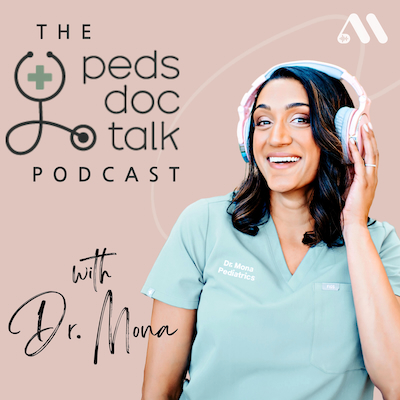

A podcast for parents regarding the health and wellness of their children.
I welcome Dr. Renee Rodriguez (Paro), who is a Pediatric Cardiologist and mom, to talk all about how we promote heart healthy habits for our patients and our own families.
We discuss the importance of creating heart-healthy habits and offer simple ways to make this a possibility for your family.
00;00;10;07 – 00;00;32;22
Dr. Mona
Hello and welcome to this week’s episode where I am welcoming Doctor Rene Rodriguez Paro, who is a board certified pediatric cardiologist and is on Instagram as Doctor Rene Porro. And I welcome her today to talk about how you can keep your kids heart healthy from a young age. In honor of American Heart Month, thank you for being here today, Doctor Porro.
00;00;32;24 – 00;00;35;01
Dr. Renee Rodriguez Paro
I’m so excited to be here.
00;00;35;03 – 00;00;50;08
Dr. Mona
Well, I’m going to be calling you Rene during the rest of the episode, but I am so glad that we got to connect on Instagram. You are one of the first doctors I started following when I got on Instagram. I love what you share in terms of mommy life, but I also love what you share in terms of your fitness journey.
00;00;50;11 – 00;00;55;06
Dr. Mona
And obviously as a pediatric cardiologist. So why did you become a pediatric cardiologist?
00;00;55;08 – 00;01;22;26
Dr. Renee Rodriguez Paro
So first of all, I’m very excited to have connected with you as well. Mona, you’re a fantastic pediatrician and have one thing, pediatric Subspecialists know for sure is that pediatricians are the backbone of our specialty. So we have I appreciate all that you do. And all that my pediatric colleagues do. But so pediatric cardiology, kind of it was it was a bit circuitous.
00;01;23;15 – 00;01;42;06
Dr. Renee Rodriguez Paro
I think I came into it a little later than a lot of pediatric cardiologists that I’ve met who have kind of found out about the field early on and kind of knew for a long time that they wanted to do that from a young age, and I wanted to be a doctor. I, got a chance to be, in the delivery room of one of my aunts, and I was eight years old.
00;01;42;06 – 00;02;12;11
Dr. Renee Rodriguez Paro
And so from there, I knew I got that sensation that I think a lot of us get when we are in medicine, that this is like a really cool thing and interesting. And it liked being in the hospital like that setting. And then when I went to med school, offered maybe OB, maybe pedes. My mom owned a preschool, owns a preschool, and I taught a lot of her preschool all through high school and really liked kids and, like, figuring out how to make them comfortable, how to interact with them, how to, you know, connect with them.
00;02;12;11 – 00;02;29;17
Dr. Renee Rodriguez Paro
And I really actually liked the adult parent relationship as well. So I really liked, you know, having discussions with the parents about certain things about their kid and kind of had a how do you frame that in a good way where they don’t get upset. And so when I went to med school, I had was pretty sure it’s going to be between one of the two.
00;02;29;24 – 00;02;56;08
Dr. Renee Rodriguez Paro
And then I rotated through OB and I liked it, but I didn’t love it. And I rotated through pedes and loved it. So I knew piece was what I wanted to do. Going in. And so when I matched in pediatrics, I did have a suspicion that I was subspecialties, initially thinking gi and then I did my first rotation as an intern on pediatric cardiology, and I was smitten.
00;02;56;08 – 00;03;15;17
Dr. Renee Rodriguez Paro
Like, love that. A lot of it is very I think certain threads came through like, a lot of it’s very surgical. You’re interacting with interventional s and surgeons a lot. And so I liked that, you know, I really liked that from when I was in my surgery training. And there are facets of OB and pediatric cardiology as well.
00;03;15;18 – 00;03;37;03
Dr. Renee Rodriguez Paro
So which I have included in my practice now. So we do fetal echocardiography and we do a lot of pre, delivery planning with parents who are with moms who are going to be having a child with congenital heart disease. So at facets of all the things I sort of had thought I may like along the way, sort of were all intertwined in this specialty.
00;03;37;09 – 00;03;42;10
Dr. Renee Rodriguez Paro
And so it seemed like the perfect fit for me. And that’s why I chose it.
00;03;42;12 – 00;04;00;16
Dr. Mona
I love it, and thank you so much for your love for general pediatricians. You know, for everyone listening. We work so closely with our subspecialists in pediatrics. So the physicians but also we I’ve had, you know, developmental specialists like speech therapists and physical therapists. It’s all a team. We all need each other. Right. General pediatricians are the first line.
00;04;00;22 – 00;04;18;07
Dr. Mona
And then we need our cardiologists to, you know, help for any concerns. We need those extra, you know, pair of eyes sometimes or extra stethoscope to take a listen and make sure, you know, are we hearing what we’re hearing. So I am so glad that you’re able to come on. Besides, you know, you’re talking about doing, like, fetal echo, you know, fetal echos.
00;04;18;11 – 00;04;23;00
Dr. Mona
What other things do you do as a pediatric cardiologist that maybe our listeners may not know? You do.
00;04;23;03 – 00;04;58;18
Dr. Renee Rodriguez Paro
So it’s a pretty, broad specialty. And what’s funny is that a lot of times, I guess not funny, but understandable when you when I say I’m a pediatric cardiologist to people, their first their facial expression is always like, oh my God, that must be so sad and terrible. And I’m like, actually, it’s really not, you know, the majority of the time when my patients come into my clinic don’t actually have cardiac disease, you know, a lot of in general, pediatric cardiology, there is a subset of my patients who have congenital heart defects, and I follow them lifelong, you know, sort of a running the gamut of a small hole in the heart to the,
00;04;58;18 – 00;05;21;04
Dr. Renee Rodriguez Paro
you know, the blood vessels are transposed to half of the heart is missing, like lots of those things. And those kids generally actually tend to do pretty well. And a lot of times you wouldn’t even know that they have heart disease, with how well they do. But so but a lot. But the bulk majority of my practice is really, it comes from my pediatric colleagues.
00;05;21;04 – 00;05;39;18
Dr. Renee Rodriguez Paro
So, you know, there’s heart murmur, a heart murmur that sounds maybe, maybe could be innocent, but maybe isn’t really and really, like, just like you said, one, an extra set of ears or somebody who really, you know, specializes in this and, and, so a heart murmur is chest pain passing out? A lot of family history of illness.
00;05;39;18 – 00;06;00;23
Dr. Renee Rodriguez Paro
So that’s a big thing that I see a lot of family history of someone who’s had an arrhythmia or has, cardiomyopathy, which is, you know, an abnormality of the heart muscle tissue or, you know, any any of those things. And because a lot of, a lot of times what we’re realizing now is a lot of heart disease that is found in adulthood or, you know, young, young adulthood is genetic.
00;06;00;23 – 00;06;23;02
Dr. Renee Rodriguez Paro
So we have to start screening the children of that. So, a lot of, I’d say probably about 40, 40% of my practice is just through, you know, something is found either through the history or the physical exam, through the general pediatric offices. And then, you know, another part which you sort of elucidated, is really more about prevention.
00;06;23;18 – 00;06;54;01
Dr. Renee Rodriguez Paro
And that’s a obviously a very growing field everywhere. Because our lifestyle, is very poor for heart health, in general. And so, you know, childhood obesity, skyrocketing like heart diseases before Covid was the number one killer of men and women in our country. We know that the disease that is acquired heart disease in adulthood, for the most part, is really from a lifestyle of how you exercise, eat, sleep, all of those things.
00;06;54;01 – 00;07;17;21
Dr. Renee Rodriguez Paro
And so I’d say probably another 30, 30, 40% of my practice is prevention. And I see these kids with, you know, patients who, do have obesity or elevated weight or high blood pressure or, pre-diabetes or high cholesterol. And then I just do a lot of nutrition counseling and heart counseling and why these things are important.
00;07;17;23 – 00;07;43;07
Dr. Mona
And when I had asked my followers on my Instagram, hey, do you want to talk? Do you want us to talk about congenital heart disease or how to keep your kids heart healthy? Most people voted for this, which is why we’re talking about this on the episode. But so many of my congenital heart disease families DM me and they’re like, please, please, please, you guys have to talk about this again so I know I’ll have you back on to talk about congenital heart disease, because so many of my followers either had it themselves as children or their child has it.
00;07;43;07 – 00;07;58;18
Dr. Mona
So I think that’s so great. But that’s a great segue to talk about how we, as parents can help keep our kids heart healthy, talking about the increased incidence of obesity and high cholesterol. What can we do as parents? Now, for a little ones.
00;07;58;18 – 00;08;25;23
Dr. Renee Rodriguez Paro
I think the most important thing with everything we do as parents is modeling good behavior. And I say this, you know, because it is kids are going to do what they they’re going to believe what they see more than they believe what you say. And so if you’re telling them, like, you need to be eating, you need to be eating a lot of vegetables, but you as a parent are not eating a lot of vegetables, then they’re going to wonder.
00;08;25;26 – 00;08;51;00
Dr. Renee Rodriguez Paro
They’re smarter than we give them credit for. And they’re going to they’re going to point that out and they’re going to recognize that. And so it really starts with us as parents and modeling the behavior. I also want to always try to make sure that people understand that developmentally, when kids start to reject certain foods, specifically fruits like vegetables, when, you know, I hear this all the time, like, well, they were a great eater.
00;08;51;00 – 00;09;14;28
Dr. Renee Rodriguez Paro
They ate all vegetables, you know, when they were period. And when they were, when they’re one and two. And then all of a sudden at like a certain age, they stopped eating the green beans I gave them, and they stopped eating the broccoli, and they did it. And so, so I think that parents take that as a they just don’t like these foods versus and I’m sure you see this versus they are exerting control.
00;09;15;05 – 00;09;40;16
Dr. Renee Rodriguez Paro
And kids want to exert control wherever they have the ability to exert control. And so at this stage it’s super important not to remove those foods from their diet. You don’t have to force it on them, but it always should be there and available. And I think just talking with kids at a, at a level where you think like maybe it’s too over their head, but like, this is why we eat broccoli.
00;09;40;16 – 00;09;58;24
Dr. Renee Rodriguez Paro
Because broccoli is really good for your heart. What is your heart to your heart pumps blood to your body. Your heart is always beating. It’s always taking care of you. So your heart taking care of you. So we got to take care of our hearts. And just having these discussions like. And don’t eliminate those foods from their diet, because I think that’s what happens a lot is that they don’t get it.
00;09;58;24 – 00;10;18;06
Dr. Renee Rodriguez Paro
They throw it on the ground, they don’t want to eat it, but you have to keep giving it to them because eventually they will start having those foods, and if they’re on their plate, they’ll put them in their mouth passively over time. But what happens a lot of times is parents will take it out, and it’s really then hard to reintroduce it again when they haven’t had it for a long time.
00;10;18;09 – 00;10;35;01
Dr. Mona
Oh, I agree, the introduction of veggies like from a young age. I actually we have a rule in our house that Ryan gets exposed to a veggie at every lunch and dinner, so we rotate the veggies around. It’s not a lot. It’s not like we’re giving him so many fancy, obscure veggies. It’s like your traditional broccoli, green beans, peas, carrots.
00;10;35;08 – 00;10;49;09
Dr. Mona
But we absolutely introduce a veggie at every lunch and dinner. And every breakfast he gets a fruit. Sometimes he gets fruit for a snack. And we’ve done this since he started solids. And yes, you’re right that they may flip a switch and all of a sudden he may start throwing that veggie on the ground that used to love.
00;10;49;09 – 00;11;05;04
Dr. Mona
But it’s the exposure. It’s the not giving up. It’s the not saying, well, he or she doesn’t like it, so I’m just not going to do it because of course children will love, we call it, you know, around the beige foods, the love, the starchy foods everyone does. But yeah, you’re right. Like, I mean, it is about exposure.
00;11;05;04 – 00;11;22;20
Dr. Mona
And that is one thing for sure that I wish more parents would hear about the exposure to veggies from a young age and not giving up. You’re not shoving it down their face, but you are exposing them and saying, hey, I see that you may not like it, just it’s on your plate. No huffing and puffing. If they don’t know, well, why won’t you eat this if they don’t know?
00;11;22;20 – 00;11;38;14
Dr. Mona
Bribery. Literally just letting it be there and letting them just see it and touch it. And maybe they’ll smell it one day and maybe they’ll just say ill one day, but one day they’ll actually put it to their lips. And so that is victory. If exposure is the victory, because your children are great veggie eaters, right?
00;11;38;16 – 00;12;09;03
Dr. Renee Rodriguez Paro
Yeah. But they give us hell. They do. Yeah. I’m going to be honest with you. They they don’t want to have it, but they but it is through. Obviously their mom is a ridiculously like insane vegetable fanatic, but like, you know, I mean, I always go, but I really do firmly believe that if we give kids a reason behind why we are telling them to do something or asking them to do something, they are more likely to do it as they grow.
00;12;09;03 – 00;12;34;22
Dr. Renee Rodriguez Paro
And I always talk to parents in clinic about this, like their frontal lobes are not yet formed. They don’t have executive decision making. They don’t have the ability to understand that. Like when I’m 60, this is going to be a part. They have zero capability of doing that. And so what we really have to do is really kind of make short term connections about things that are important for them, drawing tangible conclusions between how they feel.
00;12;34;26 – 00;12;58;21
Dr. Renee Rodriguez Paro
And that could be like, if you have a, you know, late like a late kid, like, you know, older kid like my son’s age who’s like eight, you know, he talks about, like, wanting to run long distances or keep up with his friends. And I’m always tying that back to like, hey, you know what? How we eat and feel our body has a lot to do with how we can run, how fast we can run, and how, you know, well, we can do these specific things.
00;12;58;21 – 00;13;14;25
Dr. Renee Rodriguez Paro
And so I think that trying to kind of show kids that if you do this, this especially if they’re if they’re showing interest in something or want something to be different, how if they focus on what they’re eating, it could actually benefit that thing that they are looking for.
00;13;14;27 – 00;13;30;16
Dr. Mona
Well, I love that you said this, right? Because telling a child like you said, hey, I don’t want you to have a heart problem, heart problem when you’re older, because that’s the goal here, right? We want to keep them heart healthy, but they don’t understand that, nor do they care about the the future they care about now. Who am I?
00;13;30;16 – 00;13;48;23
Dr. Mona
What am I going to do? Can I play with my friends? What’s going on? So the way you talk about that, right? How are they feeling? Is it helping them poop? Is it helping them run faster? I think that’s such a great way to look at it, because the now is what they care about. Way more so obviously we talk about veggies and I love that you just you didn’t even just mention eat veggies.
00;13;48;23 – 00;13;59;24
Dr. Mona
You talked about how to introduce the veggies and how to keep persistent with it, because I think that’s the key here. Besides eating vegetables, what other things can a parent do to encourage that heart health from a young age?
00;14;00;14 – 00;14;16;12
Dr. Renee Rodriguez Paro
So, you know, I really I do like to make nutrition the cornerstone because I do think that so many people, get into this mindset and as adults that like, well, I exercise a lot. And so and I have, you know, I’ve had.
00;14;16;14 – 00;14;17;03
Dr. Mona
Unfortunately.
00;14;17;03 – 00;14;43;10
Dr. Renee Rodriguez Paro
I’ve had a lot of I’ve had several families who’ve come in whose kids get checked for cholesterol because dad died suddenly and it was, unexpected. You know, I’ve had a couple where dad was one tragic case where dad was out going for a run on Father’s Day. All this run and, you know, just just awful things. And then the kids get checked for their cholesterol.
00;14;43;10 – 00;15;06;29
Dr. Renee Rodriguez Paro
They see their cholesterol is elevated and everybody’s just baffled. Or like, he ran every day and he was so active. But if you really, you know, it didn’t smoke and all these things, but then if you really go back to like how was nutrition? It wasn’t very and so I think a lot of people still are in this mindset that you can exercise what you eat, and that’s just not true.
00;15;07;01 – 00;15;35;27
Dr. Renee Rodriguez Paro
So exercise is vital. And I don’t want to ever give the impression that that is not something that is important, but nutrition really is probably 60 to 70% of how important and probably even more than that, honestly, how well your how how healthy you’re living to protect your heart health. And so I do think that it’s really important to have that as a focus.
00;15;36;17 – 00;16;05;26
Dr. Renee Rodriguez Paro
And, and because it’s very often that I see this scenario where a family is just devastated by somebody dying very early, who they wouldn’t have thought would have an unhealthy heart based off of how active they are. So, you know, so sort of just a blend a little bit more to that point with nutrition. I think that I think it’s just important to realize that, that at the end of the day, we really do need to be focusing on that as the primary way to make sure we’re protecting our health long term.
00;16;05;29 – 00;16;27;06
Dr. Renee Rodriguez Paro
So in addition to that, exercise, exercise is extremely important. And, and something that I think I want to get across as well to people is that in kids, exercise looks a little different than adults. You know, in adulthood we think like going on a three mile run or we think going, you know, going and doing a hit workout or a peloton bike ride or something else like that.
00;16;27;07 – 00;16;45;13
Dr. Renee Rodriguez Paro
Yeah, it’s different for kids, you know, kids getting up and being at school and moving around. Another reason why I’m like, they have to get back into school. You know, just kids being kids are like little Energizer bunnies, especially when they’re at school. They’re running around and they’re playing on the playground, they’re doing the monkey bars, or they’re just constantly on the go.
00;16;45;13 – 00;17;06;12
Dr. Renee Rodriguez Paro
And for that for them is, that’s exercise. That’s that is their form of, you know, burning off those things. And so, you know, what do you do? People may have questions right now, especially with, in Covid times where we don’t have that option. And a lot of ways are that, you know, swimming classes aren’t open and gymnastics not open, all these types of things are not open.
00;17;07;03 – 00;17;31;22
Dr. Renee Rodriguez Paro
I think we undervalue the importance of just getting up and moving for long periods of time. And that could just be going on a long walk, like going, you know, having the goal of hitting like 10,000 steps a day for everyone. If everyone was working on hitting 10,000 steps a day, that would be more than adequate to get in the amount of activity that most people need.
00;17;32;11 – 00;17;52;07
Dr. Renee Rodriguez Paro
And so I think that just values in getting up and doing something small and also just not. I try to tell families that like is for older kids and teens, like the length of a workout is honestly, I, I think we need to put less value on how long somebody works out versus how frequently we’re working out to living an active lifestyle.
00;17;52;09 – 00;18;16;26
Dr. Renee Rodriguez Paro
We’re focusing on trying to get in 20 to 30 minutes of strenuous activity. You know, that could be like or 10,000 steps a day, like six days a week. So really trying to focus on behaviors and routines that promote consistent consistency and being active throughout the day versus, you know, trying to get them to be in, you know, do like an hour long workout.
00;18;16;26 – 00;18;37;17
Dr. Renee Rodriguez Paro
And they’re only going to do it once a week, and then after that they’re going to just not do anything. So, so that, you know, that I, I think activity, being active, doing things that get you off of sitting on the couch and off of just, you know, being very, very sedentary is really important. And another thing that is something I know pediatricians are always talking about with their parents.
00;18;37;23 – 00;18;39;09
Dr. Renee Rodriguez Paro
Sleep.
00;18;39;12 – 00;18;40;10
Dr. Mona
Sleep is.
00;18;40;10 – 00;18;50;12
Dr. Renee Rodriguez Paro
So important. It is so undervalued in our society and I think is wreaking havoc on people’s health all over the place.
00;18;50;12 – 00;18;51;01
Dr. Mona
Absolutely.
00;18;51;23 – 00;19;16;04
Dr. Renee Rodriguez Paro
And sleep habits start early. Good sleep. And having your kids learn how to sleep starts early. And so I, you know, I think like being very, very from an early age, being very much like, this is your bedtime, we’re turning off your electronics. You know, this is something I capture my mind a lot. You need to power everything down 30 to 40 minutes before you go to bed.
00;19;16;10 – 00;19;38;22
Dr. Renee Rodriguez Paro
Phone is not in your room. TV is not in your room. IPad, computer. All of that means all of your screens are off 30 to 40 minutes before you go to bed, because it takes that long for your brain to shut down for you to actually go to sleep. Yeah. And so and starting that from a, you know, a young age, kids have a bedtime, having them be, you know, even right now, like we gave Juliet this little assignment a screen.
00;19;38;22 – 00;19;56;29
Dr. Renee Rodriguez Paro
It’s like this little, this little player, like a she can stick these cards in is called the Yoda player. And I gave it to her for Christmas. I thought she’d like it. And she’s been staying up, like, so late just listening to these things. So now. Now we cut that off for, like, okay, you can you have to stop with your Yoda player at 8:00 because you need to get to bed earlier.
00;19;56;29 – 00;20;16;15
Dr. Renee Rodriguez Paro
So adequate sleep is really important. And if you know, if you’re noticing that your kid is waking up multiple times a night bringing that up to your provider, like maybe they have obstructive sleep apnea, maybe they need to get a sleep study, maybe, you know, figuring out if some of like if your child is not sleeping well is super important.
00;20;17;12 – 00;20;39;05
Dr. Renee Rodriguez Paro
And sort of the tie it all up. The last thing I always cover in my visits is stress. I think that we don’t talk enough about stress. We don’t, most of us don’t manage stress very well. We haven’t really learned how to manage stress really well. And so I, I think coming up with ways to think about our mental health from a very young age is really important as well.
00;20;39;05 – 00;20;56;04
Dr. Renee Rodriguez Paro
It’s just as important as exercising our body for our physical health, addressing our sleep and our stress for mental health is just as important. And so, you know, I talk a lot about like, how do we look at life? Are we grateful for the things we have? Are we, you know, are we looking at things from an optimistic lens?
00;20;56;06 – 00;21;13;23
Dr. Renee Rodriguez Paro
Do you, you know, what do you like to do as a hobby, especially in like the teen years when kids, give up all of these things for SATs and acts and AP classes and they just completely stop their sports and they stop doing everything they like. You know, I really try to talk with, like, tapping back into those things, like, what do you like to do?
00;21;13;23 – 00;21;30;21
Dr. Renee Rodriguez Paro
Do you like to draw? Do you like to paint? Do you like to create music? Do you like to dance like and really kind of get at it because everybody has something that really gets them into a de-stress type of zone. And I and I encourage that. I say, you know, okay, how does it feel when you’re when you’re, drawing?
00;21;30;28 – 00;21;49;11
Dr. Renee Rodriguez Paro
Does it feel like time just passes without you being able to even imagine you’re doing it for an hour and you’re like, how? And I felt like five minutes and like, yeah, you know, you’re in a flow state and that’s actually helping you reduce your stress. So an hour of doodling for you, it’s not wasted time. It’s actually benefiting your stress levels and lowering your stress levels.
00;21;49;16 – 00;22;08;08
Dr. Renee Rodriguez Paro
So I think it’s just like all of those little things, if we can think I heard a, you know, I read a book a long time that was like the four pillars of health are nutrition, exercise, sleep and stress. And if we can be thinking about how we’re taking care of all of those things, you know, for all of us, but the younger we teach it to our kids, the better.
00;22;08;08 – 00;22;12;09
Dr. Renee Rodriguez Paro
And more, you know, helpful it will be for their heart health for the future.
00;22;12;11 – 00;22;28;12
Dr. Mona
And all of those things are interconnected. We know that, right? Like if you don’t get good sleep, you’re going to make poor choices in what you eat. You’re going to be more stressed. You’re going to more or less likely want to work out because you’re not getting sleep. And everything is a vicious cycle, right? Like that balance is so important.
00;22;28;12 – 00;22;43;28
Dr. Mona
And you said it earlier that the modeling that we have to do as parents is hard. I cannot tell you how many times I have parents bringing their child and telling me that I need to tell the child, hey, you need to do x, y, and Z. And I ask the parent, like, well, what are you doing? I’m like, what are you doing in your house?
00;22;43;28 – 00;23;02;25
Dr. Mona
And in a nice way, right? I’m telling them, and I, I give that tough love because I think it’s important that parents look inside themselves and say, what can I change? Am I using my screens right before bedtime? Am I eating this food that maybe I should balance a little bit more? Or am I not prioritizing exercise to help reduce stress and, you know, improve my heart health and improve my health overall?
00;23;02;25 – 00;23;22;03
Dr. Mona
So that modeling is key. You said the four pillars of health. I one of my favorite things that I’ve seen is the six doctors. The six doctors are sunshine, water, rest, air, exercise and diet. And it’s so simple, I like that, I love it, it’s so simple to me because it’s literally what I envision, a quality of life.
00;23;22;03 – 00;23;42;26
Dr. Mona
And I, you know, in America, I think we forget these essentials, I really do. I, I look at other countries that don’t have the rates of heart disease that we do, and especially developed countries that are not working as much as us, that have a little more balance with being able to do activities outdoors. And we are just working so much as Americans that it really it really affects our health.
00;23;42;26 – 00;24;00;08
Dr. Mona
And like you said, the mental health has a huge component on the physical health. But I think this is such a great conversation because we can teach our children this from a young age by modeling it, and also not even just by telling them, well, I said, I told you so and that’s why you’re going to do it in that moment, saying, well, look at how amazing it makes you feel.
00;24;00;08 – 00;24;19;10
Dr. Mona
I saw you running so fast, and I’m so proud of the effort that you’re putting into this or that or how you built something. And it’s because you’re doing so well with, you know, exercising and eating. Right. And I’m so proud of you. You know, you should be proud of yourself for what you’re doing for your body. You know, I always say, like, I always tell my kids in my office, I’m like, you should be so proud of what you’re doing.
00;24;19;10 – 00;24;41;25
Dr. Mona
And they’re like, I am proud. Versus I’m proud. I, like you are you should be proud because you are doing an amazing thing for your health. Are there any other tests that are typically done? I know, obviously, I know that the cholesterol screening, but is there anything else that I’m missing? Because that’s one screening test. Obviously, if a child is having a, you know, risk factors for diabetes and we do do some screenings, but any other screening tests you would want to tell our listeners about.
00;24;41;25 – 00;25;05;18
Dr. Renee Rodriguez Paro
So in 2011, the American Academy of Pediatrics came out with a recommendation that all children between the ages of nine and 11 should undergo cholesterol screening. If there is a family history of early coronary artery disease or high cholesterol in multiple family members, and you test a little earlier, probably between like six and eight, I don’t know that all practices actually really go with those guidelines.
00;25;06;17 – 00;25;26;00
Dr. Renee Rodriguez Paro
But there is more screening than there previously used to be. Which we are picking up a lot more kids who necessarily wouldn’t have shown up on the radar of a pediatrician. Their normal weight, the, you know, there isn’t a really significant family history, but the blood tests, you do the blood tests and they have an LDL of 150.
00;25;26;00 – 00;25;49;06
Dr. Renee Rodriguez Paro
And it’s like what? You know, and it’s shocking to the to the parents, to the kids. And the first thing I always hear from parents is like how I never got screened. Like, how are we? Like, I don’t remember ever knowing my cholesterol levels when I was nine. And then I come back to say to them, the reason why we test now is because we have such a huge incidence of coronary artery disease in adulthood.
00;25;49;06 – 00;26;12;07
Dr. Renee Rodriguez Paro
So whenever we see something that’s happening a lot in adulthood, and we know it can be linked back to something in childhood, we as pediatricians start to screen more of those things earlier, sort of like breast cancer prevention, colon cancer screening, all of those things to give a little more education. So there’s, you know, to really with most cholesterol panels, you get two of your bad cholesterol, which are triglycerides and your LDL cholesterol.
00;26;12;12 – 00;26;32;25
Dr. Renee Rodriguez Paro
Your, triglycerides are tied a bit to heart health. But the the one that is a little bit more heart tied to heart disease is the LDL cholesterol. But so it tests for both of those. And then your HDL cholesterol, which is your good cholesterol, which if it’s low is worrisome for heart disease. So you want that to be in a normal range or a high range.
00;26;32;25 – 00;26;53;22
Dr. Renee Rodriguez Paro
So definitely the cholesterol panel. Definitely. I usually recommend fasting blood sugar and hemoglobin A1, c both to see, you know, the hemoglobin A1 C will tell us the measure of your heart, your blood cholesterol over a three month period of time, a little bit more longer term. And the fasting fasting blood sugar does as well. But I, you know, in adult world they use a lot of the hemoglobin A1, C.
00;26;53;22 – 00;27;18;15
Dr. Renee Rodriguez Paro
So I end up asking for those two things. And then the last one, is that I recommend usually is the liver trans emanations. So alt and AST and that’s really to look to see if there’s any evidence of fatty liver. If the alt is a little elevated when the cholesterol is elevated and the child is overweight, then that can be an indication that there’s possible, possibility of some fatty liver that is starting to develop.
00;27;19;05 – 00;27;40;02
Dr. Renee Rodriguez Paro
So those are typically sort of the metabolic labs that I recommend. I will sometimes recommend a thyroid, panel if it’s never been checked before or if there’s a significant family history or symptoms that seem like there could be some sort of thyroid issues that are going on, and a lot of times parents just like to have that checked, when these things are sort of happening.
00;27;40;05 – 00;27;56;17
Dr. Mona
And like really saying, we your pediatrician is going to be the one to guide you through the screening process if you’re concerned. So if you’re like, do I need to get my child’s, liver functions checked or do I need to check their hemoglobin A1? See, your doctor will look at their growth chart, family history, all of those things.
00;27;56;17 – 00;28;25;04
Dr. Mona
Which is why you need to go to your doctor. Because they’ll guide you. Outside of the recommendations of just a normal cholesterol screening that’s done for all children. So many, many families come in and they deny the cholesterol screening at nine and ten because they don’t want to poke their child. And I actually say, like you said earlier, that that gentleman who who died running, who, you know, was very active and probably looked like he was healthy, we can’t always we’re not going to be able to tell if a person has good heart health from the outside all the time, right?
00;28;25;06 – 00;28;47;00
Dr. Mona
Meaning especially in Indian Americans. I’m Indian. A lot of Indian Americans are super thin and they don’t have the best diets. And so when you look at that, they’re the fat is only going one place. We joke it’s basically going to their arteries and it’s really important that we remember that for older adults, right. For children I’m not concerned, like Rene said, like in the media, that they’re going to have, like high cholesterol in their arteries.
00;28;47;00 – 00;29;07;23
Dr. Mona
But we don’t want that for the future. And the cholesterol screening I’ve picked up familial high cholesterol, meaning a family. It runs in the family. And so I would not deny those testing screenings. Right. It’s important. Like Rene said, these are screenings that are done. If it’s normal, great. If it’s abnormal, we have to monitor that and your doctor will guide you as to what the monitoring process would be given the levels.
00;29;07;23 – 00;29;23;29
Dr. Mona
It doesn’t mean that they have to come back every month. It means usually six months to a year. Maybe not until another five years, depending on the number. But don’t deny the screening test because as pediatricians, we don’t do a lot of blood tests. So when you are being asked to do one, it’s for a reason. And I would just say do it.
00;29;23;29 – 00;29;27;01
Dr. Mona
It’s just for to make sure. And if it’s normal, it’s normal.
00;29;27;03 – 00;29;56;06
Dr. Renee Rodriguez Paro
You know something else we’re learning through all of this. Is that there are probably a lot of genetic variations that we don’t really know the full picture of when it comes to, inherited cholesterol problems. There are, because this is true and we’ve seen it, you know, just in regular life that there are some people who eat terribly, you know, who just really taken a lot of, like, very high cholesterol foods.
00;29;56;06 – 00;30;29;29
Dr. Renee Rodriguez Paro
And. Yeah, and they’re, they’re not on statins and their cholesterol numbers are fine. And there’s no body in the family who has heart disease and all these things. And and what I try to tell people is that all of us are on a different genetic variability. And so there are some people who actually, you know, and I love like I love the sort of practical my practical vegan colleagues like Danielle Bilodeau like she, you know, she talks about this a lot in, in the vegan community, people who are not eating pretty much any cholesterol, especially people who don’t want to have like, olive oil in those things, who still, will have a heart attack
00;30;29;29 – 00;30;58;20
Dr. Renee Rodriguez Paro
and will want to go off patent. But it’s like statin, but like, they they genetically produce a lot of cholesterol. And I think people always yes, it’s important to lower your amount of cholesterol intake. But we there’s two ways in which cholesterol is is as in our bodies through what we eat and through what our body produces. And there are certain people, because of their genetics, who produce a high amount of cholesterol at their baseline.
00;30;58;24 – 00;31;29;18
Dr. Renee Rodriguez Paro
And no, no amount of fiber that you can eat or non amount of cholesterol that you can eat will actually lower your cholesterol. And so, you know, and these are the families that we’re seeing where people have heart attacks at their in their 30s or you know or younger. And so, so you know, I have had to start some kids on statins who have really just their cholesterol numbers are high and, and it’s, it’s really hard for the families and, and sometimes it’s a hard discussion because nobody wants to start their kid on a, on a medication.
00;31;29;18 – 00;31;37;20
Dr. Renee Rodriguez Paro
But yeah, when it’s when, when you’re, you know, but we have to balance that because there is there are certain people who.
00;31;37;23 – 00;31;39;00
Dr. Mona
Who, who.
00;31;39;00 – 00;32;05;13
Dr. Renee Rodriguez Paro
Just have this high number and are at extremely high risk of having heart disease early, and having these sudden episodes that are devastating. So we’re, we’re learning a lot more in those in, especially in sort of going back to what I talked about earlier, these parents who are like, why do we know about this? And I go back to say, because we have such a high amount of heart disease in adulthood, and we know it ties back to earlier.
00;32;05;15 – 00;32;26;19
Dr. Renee Rodriguez Paro
This is why we test now. And and it it’s sometimes hard for us to be talking about these things earlier, but it’s harder to be having these discussions when you’re 30 years old and you’ve had your first heart attack and now you have scarred heart from it. So we have to, you know, so so it is important these screening tests are there for a reason.
00;32;27;06 – 00;32;29;15
Dr. Renee Rodriguez Paro
And they are they can be lifesaving.
00;32;29;17 – 00;32;42;19
Dr. Mona
Absolutely. Agree. This is such a great conversation. I know I’m going to have you back again for another episode, especially about the congenital heart disease that was requested. But what would be your final message to wrap up to all the parents who are listening?
00;32;42;21 – 00;33;02;19
Dr. Renee Rodriguez Paro
Number one, just like we said, modeling the behavior that you want your kids to see is so important. And and I try to sort of throw it back to the parents that, like, you want them to live a long and healthy life. They want you to live a long and healthy life. So you want to be there for them.
00;33;02;19 – 00;33;28;16
Dr. Renee Rodriguez Paro
And so, so taking care of your own health to model that to them so that they take care of their health. It’s it’s a trickle down effect. This is how we. Yeah, this is how we change generational disease that has left families with devastation throughout their lifetime. Like we all, we can all change the we can change the direction of the health of the for generations of our family based off of how we model behavior.
00;33;28;21 – 00;33;58;28
Dr. Renee Rodriguez Paro
And so the most you can do, especially for my parents who are dealing with older kids or teens, where it’s a real struggle, is to do the things you want them to do yourself. And be very you said this in this, I just I’m so happy you said this. Be very positive in your messaging. Be very congratulatory. Give them a lot of praise for seemingly very small things, like something I do with my kids is like, we’ll get donuts every once in a while.
00;33;58;28 – 00;34;18;04
Dr. Renee Rodriguez Paro
And my son loves donuts. And he will. He will eat most of it, and then he’ll be like, they’ll have a little bit of it left. And he’s like, you know, I don’t want the rest of this because I’m full. And I always tell them, I’m so proud of you for recognizing that you don’t you want it’s really yummy and you like it, but you realize that if you eat more of it, you’re going to feel bad later and it’s not worth it, you know?
00;34;18;04 – 00;34;46;14
Dr. Renee Rodriguez Paro
And so, like, call those things out when you see those kids, your kid doing something that is from them intrinsically, that’s it’s a good thing that they’re doing and don’t don’t also expect things to change overnight, like if we’re at a place where vegetables are nowhere in somebody’s diet or we’re really struggling with activity and movement, don’t expect that it’s going to automatically, in a week, get better.
00;34;46;17 – 00;35;07;15
Dr. Renee Rodriguez Paro
It’s going to take time. Try the best that you can not to make it a negative thing, and really try to make it a positive thing and realize that you’re just going to have to put in daily, consistent effort to make sustainable changes in the long term. Don’t sacrifice your relationship with your child trying to force something on them that they’re just not ready for yet.
00;35;07;20 – 00;35;18;08
Dr. Renee Rodriguez Paro
Model it. Be positive about it, and eventually they will see that and they’ll start to adapt to those changes. I guess that’s my biggest piece of advice.
00;35;18;10 – 00;35;35;05
Dr. Mona
Yeah, that is so great. I love talking about this with you. And I love that, you know, on your page I’m going to touch her Instagram handle. You you do model this, right. It’s just so nice to see that it’s possible. It does mean balancing. Like you just said, you can still have donuts. You can still do all the fun things that we do as parents.
00;35;35;07 – 00;35;50;27
Dr. Mona
You’re not restricting your child from these things. That’s not what we want. You or anyone to do, because that’s not good for anyone. But it’s about the balance. It’s about just being a model for your child. And like Rene said, it’s just we want to live a long and healthy life for our children as much as we want them to live a long and healthy life.
00;35;50;27 – 00;35;59;00
Dr. Mona
And I think that’s so beautiful. Thanks again, Renee. I’ll talk to you soon. I can’t wait to have you on again. I hope you have a great day.
00;35;59;01 – 00;36;00;27
Dr. Renee Rodriguez Paro
Thanks. Doubt this is awesome.
00;36;01;00 – 00;36;16;20
Dr. Mona
Thank you for tuning in for this week’s episode. As always, please leave a review. Share this episode with a friend. Share it on your social media. Make sure to follow me at PedsDocTalk on Instagram and subscribe to my YouTube channel PedsDocTalk TV. We’ll talk to you soon.
Please note that our transcript may not exactly match the final audio, as minor edits or adjustments could be made during production.
Need help? We’ve got you covered.
All information presented on this blog, my Instagram, and my podcast is for educational purposes and should not be taken as personal medical advice. These platforms are to educate and should not replace the medical judgment of a licensed healthcare provider who is evaluating a patient.
It is the responsibility of the guardian to seek appropriate medical attention when they are concerned about their child.
All opinions are my own and do not reflect the opinions of my employer or hospitals I may be affiliated with.