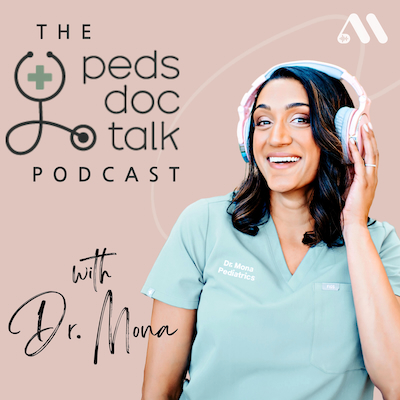

A podcast for parents regarding the health and wellness of their children.
I welcome my friend Dr. Marta Perez (on Instragram as @dr.martaperez), who is an OB and new mom. We chat about motherhood and everything that got us here today.
We share a heart-to-heart about the assumptions that are made of us as physicians and doctor moms.
00;00;08;19 – 00;00;33;26
Dr. Mona
Welcome to this week’s episode. You all are in for a treat because I have my Instagram bestie, Doctor Marta Perez. She is an Ob-Gyn and she is on the episode today to talk with me all about motherhood as an OB, as a pediatrician, and a lot of the assumptions that a lot of our followers think of us. So we’re going to be hashing all that out.
00;00;34;00 – 00;00;40;25
Dr. Mona
I could not think of another person better than Doctor Perez to come on this episode. So thank you for joining me, Marta.
00;00;40;28 – 00;00;47;11
Dr. Marta Perez
Mona, thank you so much for having me. I love that we are Instagram besties and we actually got to meet in real life. That was wonderful.
00;00;47;14 – 00;01;05;29
Dr. Mona
Yes, before Covid obviously we you were the only Instagram friend that I’ve met so far. Obviously with Covid happening, there was hope that maybe through conferences I would meet other doctor moms or other people I’ve met on Instagram. But you are the only one I’ve met so far. We met in Florida and I love you in real life.
00;01;05;29 – 00;01;24;06
Dr. Mona
I love you on Instagram. So I’m just so glad that you are here to join me. And for anyone who is listening who doesn’t know of Doctor Perez, she has an Instagram account as well as a YouTube channel. I’m going to be attaching that to the show notes for this episode. Doctor Dot Marta Perez on Instagram and her YouTube channel.
00;01;24;06 – 00;01;47;24
Dr. Mona
I’ll be linking as well. We’ll talk about that at the end. But again, we’re going to be talking about just some things that people think of us. Again, I asked my followers on my Instagram account as well as she asked her followers things that you would assume of us as doctors, an OB, a pediatrician, and as mothers. And we’re going to really just explain whether that’s true or not and just some real down to earth kind of education through the process as well.
00;01;47;25 – 00;02;07;25
Dr. Mona
So the first thing I wanted to talk about was how one of the assumptions that people think is that you felt comfortable as an OB, being an OB and going through pregnancy and labor and delivery, that you felt comfortable and didn’t hear the process. What do you think? How did you feel being an OB and during your whole process being pregnant?
00;02;07;28 – 00;02;27;21
Dr. Marta Perez
So this is such an interesting question and an interesting answer because my first response would be, yeah, you’re right. Like I didn’t fear it, but I think that it’s a little bit deeper than just saying, oh, that’s right. And I think that the real reason here is that. So as an OBE, I see tons of joyous, wonderful, uncomplicated moments and something can be complicated and scary and also joyous too.
00;02;27;21 – 00;02;54;01
Dr. Marta Perez
But I also see some of the most tragic, hardest things that a family can go through. And it is just heartbreaking as a provider, to be involved in those moments, helping families through grief and disappointment. And it can be, you know, as then when I’m in that seat myself, I can see all of the things that can go wrong, the things that happen to one in every 10,000 people, you know, I’ve been there for that, or even 1 in 1000, which is not that rare when you’re a doctor, but rare if you’re a patient.
00;02;54;01 – 00;03;23;03
Dr. Marta Perez
I see all those things. But I think what makes the process less scary? Like you could let all of those negative things make you more anxious, like, oh my God, look at the laundry list of things that could happen to me. But I think, and you might feel this way too. Instead, what I see is that while human beings are resilient, people experience tragic loss and horrible disappointments, and they grieve and they cope, and they go on to still have joy in their lives.
00;03;23;03 – 00;03;44;02
Dr. Marta Perez
And so it’s something that you can recover from. So yeah, I see it’s not that I look at complications and I’m like, oh, I’m not worried. Nothing is scary because there are really scary moments in the pregnancy and birth process. It’s that, well, I hope those scary things don’t happen to me if they do. I know that I take inspiration from the resilience of my patients to manage them.
00;03;44;15 – 00;03;56;22
Dr. Marta Perez
As far as the scary stuff, I also picked a team and we can talk more about this later. Picked a team that I trust in my, you know, birth and hospital care and etc. and so that helps a lot with the scary situation too, because I just know I’d be in the very best hands.
00;03;56;27 – 00;04;16;16
Dr. Mona
Yeah, I think you said it perfectly. And I mean, if you’re going to ask the question to me as a pediatrician, like, did I feel prepared being a mom, having been a pediatrician? There definitely is insight, understanding, okay, this is the good things that happen. This is the hard things that happen. Yes, I do think it helped a little bit a lot maybe, but it still is a process that we go through, right?
00;04;16;17 – 00;04;32;06
Dr. Mona
Like as a mom, even though I know what to do with sleep and behavior as a pediatrician, when it’s your own child, it makes it a little more difficult, right? But you still know, okay, how do I troubleshoot? What do I need to do here? When do I need to be concerned. And there is obviously insight in that.
00;04;32;06 – 00;04;40;24
Dr. Mona
So I definitely agree with you. Did you feel that you worried less or more about the whole process with your experience as an OB?
00;04;40;28 – 00;04;58;08
Dr. Marta Perez
Just as a quick side note, you guys can probably hear my baby cooing, yeah, we forgot to say that in the beginning. Oh yeah. Yeah. So that’s what that noise is. My seven week old. I feel like I worried about different things. I would say I think a lot of people are concerned about first trimester miscarriage. I was of course like hesitant about that.
00;04;58;08 – 00;05;18;29
Dr. Marta Perez
I don’t think I bonded to the with my pregnancy at all in the first trimester, which I think is normal, but I also, after the first trimester, like, I see a lot of things that happen early in the second trimester and until that kind of viability at 24 weeks. And so I was really, I think maybe some people are like, oh, I made it first past the first trimester.
00;05;18;29 – 00;05;34;18
Dr. Marta Perez
It’s going to be a healthy pregnancy. After this, I think I waited even longer till I felt comfortable being like, okay, I, I’m like starting to feel more relaxed now. I was more I was relaxed the whole time, but definitely like there was anxiety there through like my anatomy scan, I would say, until I reached viability at 24 weeks.
00;05;34;18 – 00;05;35;29
Dr. Marta Perez
And then there was like a drop off.
00;05;36;03 – 00;06;00;27
Dr. Mona
Yeah, the assumption that people had was that we worry less because we’re physicians and we have our experience. And I will say, in pregnancy, I had more anxiety than I ever had. And I know that can happen to a lot of women, but I was surprised as to how I had, yeah, anxiety. And I was worried and it was very, very new to me because I had some high functioning anxiety before pregnancy.
00;06;00;27 – 00;06;21;15
Dr. Mona
But then it really, really got worse for me. And then it started to subside. My anxiety was worse in that first trimester, like you said, going into those ultrasound, maybe knowing what we know in regards to, you know, everything else with my delivery and everything else that happened. For anyone who does know, obviously you can go to my Instagram if you if you are not sure what I’m talking about.
00;06;21;15 – 00;06;40;11
Dr. Mona
But I definitely did have worry. You know, I was like, well, what is going to happen? Like you said earlier, we see a lot of good as doctors, but we also see the rarity. So it was really hard finding that balance of being optimistic, which we know outcomes can generally be good because of how resilient children are and how resilient human beings are.
00;06;40;11 – 00;07;03;04
Dr. Mona
But it was really hard not to think about, well, what if it was that 1% chance? What’s going to happen with this? It was really hard to put that in the back of your mind when you’re tired and grieving and just looking at your baby hoping for the best, but it does help having that experience of knowing, okay, overall, even if we had to go through some hard times, there are resources and this is what we would do.
00;07;03;04 – 00;07;15;16
Dr. Mona
We know. We see it all the time. We see so many families who overcome, struggle and overcome hardship and like you said, come out on the other side in a great light. So that was very optimistic. And I think that does help, like you said.
00;07;15;18 – 00;07;46;12
Dr. Marta Perez
Yeah. And I think that the more anxiety that you touched on, you are definitely not alone. Like you said, in experiencing increases anxiety and pregnancy, for most people, it’s the first time there’s a major thing going on that they really can’t control, especially with their body. And there is with that. That’s that induces anxiety. And then society has all of these crazy expectations and myths and all these pressures on a pregnant person at the same time.
00;07;46;12 – 00;08;03;21
Dr. Marta Perez
So all of a sudden you start questioning, am I eating right things or drinking the right things or doing this or that? So I think I had less anxiety from those perspective. Just because I see and I understand more like someone, if someone says, oh, this isn’t good for pregnant people, I’m not like worried and googling I’m like, no, that’s B.S., that’s not true.
00;08;03;21 – 00;08;19;01
Dr. Marta Perez
Or yes, thank you. I know that and I don’t do it. So you’re not alone. And that I think being in OB definitely decreased those anxieties for sure, because I was like, nope, that’s a myth. I don’t have to worry about that. And then I would say I didn’t do googling, you know what I mean? Like, I didn’t have to look stuff up for myself.
00;08;19;04 – 00;08;37;14
Dr. Marta Perez
But on the flip side, you know, at 24 weeks, which is generally considered viability, or when your baby would, you know, have a long Nikki state, okay. Chances at survival. If born, I was pretty feeling pretty good. Feels like a milestone. I’m sure you felt that way about four weeks. All of it. And my switchover day and pregnancy was on Monday, so I’m like Monday morning.
00;08;37;14 – 00;08;55;11
Dr. Marta Perez
I’m 24 weeks. This feels like a milestone. I get to work, and the first patient on the list is someone who’s 24 weeks and two days who had just had a stillbirth, and I was like, okay, well, you know, you’re never out of the woods. But it was just such a contrast for me that morning being like, oh yeah, you know, you can never in this job.
00;08;55;11 – 00;08;57;12
Dr. Marta Perez
You can’t really forget what could go wrong at all times.
00;08;57;12 – 00;09;03;14
Dr. Mona
But oh, definitely. Did you follow all the rules during pregnancy?
00;09;03;17 – 00;09;05;20
Dr. Marta Perez
I think you and I talked about loving this question.
00;09;05;23 – 00;09;17;16
Dr. Mona
I should put quotes. The assumption is that we followed all the rules, meaning we did everything by the American College of Obstetrics and Gynecology, the AP basically that were rule followers.
00;09;17;18 – 00;09;39;12
Dr. Marta Perez
Yeah, well, to an extent, absolutely. Yes. Like I vehemently disagree with the, economist who wrote a book on pregnancy saying some mild to moderate alcohol consumption in pregnancy is probably safe. I just don’t think that we have the data to make that call for everyone. I had like a sip here and there about quite like Michael had a nice glass of wine.
00;09;39;12 – 00;09;56;15
Dr. Marta Perez
Maybe I call me, I’ll try it. I’ll take a small sip, but I didn’t. I didn’t drink during pregnancy at all. There’s nonalcoholic beer scenes are kind of fun every now and then. But there’s other things that are just kind of like people really misunderstand some of the like, do not eat this in pregnancy. And why, like, like the soft cheeses.
00;09;56;15 – 00;10;16;24
Dr. Marta Perez
I see people saying they from soft cheeses when really if you’re worried about listeria, it’s Mexican soft cheeses like queso fresco and queso blanco. So I like stayed away from those. If we’re out eating Mexican, I got it without those cheeses. I definitely stayed away from those cheeses known to have listeria. And then the other big hitters for listeria are like lettuce, fruits and vegetables.
00;10;16;24 – 00;10;40;03
Dr. Marta Perez
So I tried to always wash those to decrease listeria risk. But there’s not a huge listeria risk with like, sushi. Like if you’re getting pretty good seafood, Listeria is not the concern. Like, yeah, anyone can get sick from bad seafood, but I’ve never in my life gotten sick from seafood like so. I was like, I hate sushi. And I think that most pregnant people are like, oh, I can’t eat sushi in pregnancy.
00;10;40;06 – 00;10;56;00
Dr. Marta Perez
Like I can eat sushi. I see a lot of that with cold cuts, too. If you heat them up, you can kill right before you eat them. You can kill the listeria. So I don’t really like deli meats. I’m not a deli meat person. But if I was going to have it, I just pop it in the microwave for, you know, a minute or something to make it a hot deli sandwich.
00;10;56;00 – 00;11;00;08
Dr. Marta Perez
Again, I don’t like deli meats. I didn’t eat those, but, that’s the way to eat it safely. Yeah.
00;11;00;08 – 00;11;19;12
Dr. Mona
And I mean, a lot of cultures, like, for example, in Japan, they eat high quality, you know, raw fish like sushi or poke or something like that. In Hawaii too. So there definitely has been consumption. And I think it’s all about, like you said, understanding the risk, but is how high is that risk? I didn’t eat sushi just because I just didn’t.
00;11;19;12 – 00;11;36;02
Dr. Mona
But, I did have some deli meats here in there. But it wasn’t like I was a complete rule follower in postpartum. And with being a pediatrician, I’m pretty much a rule follower for all the safety stuff. Like safe sleep. I did follow all the rules just because, for me, the risk wasn’t really worth it.
00;11;36;09 – 00;11;53;20
Dr. Mona
I know people do co-sleep, but for me, I just didn’t feel like it was something that I would be able to do. I would feel more anxious co-sleeping versus having the baby separate, you know? So some people say the opposite, but I just couldn’t do that. So for me, I didn’t I didn’t do the co-sleeping, which is what the AP says.
00;11;53;22 – 00;12;09;11
Dr. Marta Perez
That the choice we’re making to I mean, he’s not at the age where he even could yet, but I don’t even breastfeed sitting in bed. During the nighttime, I get up and go to the chair that’s right next to the bed. Just because I don’t want to have nightmares that I rolled over on him, even though I don’t think I would do that.
00;12;09;11 – 00;12;16;13
Dr. Marta Perez
I’m a safe sleeper. Yeah, I don’t want to. I want to avoid the anxiety of thinking I did it and doing it. So I sit in the chair next to the bed.
00;12;16;15 – 00;12;33;25
Dr. Mona
Yeah, totally. And I mean, we made that same decision. I know it happens. But for me, I was like, you know what? I just don’t trust myself completely to not roll over. And what if my husband rolls over or something like that? So was just, something that we made the decision to put the baby, put him in that crib and or bassinet, and it worked for us.
00;12;33;29 – 00;12;52;01
Dr. Mona
But besides that, I mean, rule following wise, generally, I do. I mean, there are some things this would be a whole other episode where I’m like, you know, the he says some things and I’m a little bit different. I didn’t give my son vitamin D drops were in Florida. He was formula fed. And they say, you know, if your child is getting less than 32oz, you have to give vitamin D drops.
00;12;52;03 – 00;13;06;19
Dr. Mona
I was like, well, I get some. Like, he doesn’t have rickets. I’m not worried about it. So those kind of things, there are some things that I kind of go back and forth on, as a pediatrician, but I could do a whole other episode on the AP guidelines that could be, you know, different in some ways.
00;13;06;19 – 00;13;17;19
Dr. Marta Perez
Yeah, yeah, yeah, I think that all of it, all of a recommendations, I think that I see some people misunderstanding some guidelines and I didn’t have to like, misunderstand them. Like the thing about food or whatever.
00;13;17;21 – 00;13;45;28
Dr. Mona
Yeah. And I mean, I, I think that’s why it’s so great having our accounts, you know, because we are also mothers. And so now we can say, okay, this is what is making our peers concern. Right? Like a fellow mother’s worried about such or fellow pregnant women or pregnant people concerned about such and such. Right. So like the whole, metals and infant foods, that whole thing, like so many of my followers were so concerned and I didn’t even think twice about it being a concern.
00;13;45;28 – 00;13;48;12
Dr. Mona
I was like, okay, here it goes again, right?
00;13;48;18 – 00;14;08;26
Dr. Marta Perez
Because I am not eating yet, but I felt the same way. I’m like, metals are a part of like the way plants are grown. Of course they’re going to be in baby foods, and there’s probably some stricter process of trying to take them out that maybe they’re trying to move towards. But certainly like because I, you know, even a baby eating like actual vegetables that you made versus repackaged is going to have those too.
00;14;08;26 – 00;14;09;11
Dr. Marta Perez
Right?
00;14;09;11 – 00;14;31;23
Dr. Mona
And so I think those kind of things really like people’s assumption is that we don’t worry so much about those clickbaity news stories. You know, we understand, okay, this is something that is just totally fearmongering. And, I mean, I can go back like 3 or 4 years when I, you know, when I thought of creating feedstock or I was like, oh, yeah, this is why I’m creating this, because there’s so much fear about everything and there’s no solutions.
00;14;31;23 – 00;14;45;08
Dr. Mona
There’s no like, okay, well, here’s the information. Okay. Now you just deal with it. There’s no like, well, what does it mean? What do you do with it? As someone who’s pregnant, as someone who’s, who’s a parent. So that is what’s so frustrating. I think for a lot of, people out there.
00;14;45;15 – 00;15;01;27
Dr. Marta Perez
It’s so funny that you say that because the day I created my account in like March 2019 or whatever was a patient half jokingly, but but honestly wanted to know. Two said she saw something online. It said pregnant women can’t like, put their clothes in and out of the dryer.
00;15;02;00 – 00;15;02;21
Dr. Mona
Oh my gosh.
00;15;02;21 – 00;15;16;24
Dr. Marta Perez
And you know my response back in clinic that day, I was like, no, that’s not true. And then I was like, her husband was with her. I was like, actually, that is true. He has to do all the laundry. But, you know, but seriously, I was like lot of things people see, it’s just like, not fair that what you’re consuming.
00;15;16;24 – 00;15;38;05
Dr. Marta Perez
One thing that you and I don’t have to worry about, which we see so much on the internet, is we don’t have to worry about vaccines. We know vaccines are full stop, healthy, improve outcomes for pregnant women and for babies, and we get to block out all that noise. But I understand why people that anti-vaccine movement just curls its way into people’s minds in a way that can be really scary for people.
00;15;38;05 – 00;15;55;22
Dr. Marta Perez
I understand that that’s why I spend so much time on my platform, you know, demystifying vaccines, encouraging fluent in pregnancy. And then, of course, people have been asking me, Will he get vaccines on the normal schedule? And he already has, and he will continue to. I have zero concerns about vaccines. I know that they save lives and improve lives.
00;15;55;22 – 00;15;57;22
Dr. Marta Perez
I’m not worried about risks.
00;15;57;25 – 00;16;17;19
Dr. Mona
Yeah, absolutely. And I oh man, it is hard seeing so many well-meaning parents concerned about that when it really shouldn’t be a concern, when this movement has really gone out of control, especially in this pandemic. And it’s hard because we’re in a pandemic. You’re like, well, guys, don’t you understand that this virus is the vaccine is what’s going to help us get out of this pandemic.
00;16;17;26 – 00;16;43;03
Dr. Mona
And also it’s just it boggles my mind how they’re able to infiltrate so many different parents minds about all this because it is totally beneficial. And same with me. Like it was very much like, okay, this is what’s going to happen. I will say I did have a little hesitancy only because of Ryan’s seizures. So there is one vaccine that is very, very low risk for seizure activity, and that’s the DTaP vaccine.
00;16;43;03 – 00;17;01;20
Dr. Mona
And that’s very low risk. Everyone. And I’m talking like I’ve seen it once in the last eight years. That child is perfectly fine. But it is a post sequelae. Right. So because of Ryan’s seizure activity, my neurologist and we had talked about it. And so there was a little bit of hesitancy at his two month visit of, okay, I hope his seizures don’t happen.
00;17;01;20 – 00;17;18;29
Dr. Mona
And of course he’s fine. And so then that was that. But here on out, there’s no hesitancy. There’s literally like, okay, here we go, here we go. But I agree with you on that. Did you have a lot of questions at your OB visits as an ob gyn is we don’t have any questions that doctors visits.
00;17;19;01 – 00;17;37;11
Dr. Marta Perez
Yeah, that would be a correct assumption. No, my OB visits were very much social visits with my friend. It was my OB. That being said, there there was times when I’d be like, I wonder if I feel this. And Michael was always like, please don’t be your own doctor, please call your doctor. And, I never did.
00;17;37;11 – 00;17;57;09
Dr. Marta Perez
But the concerns were never like that serious. So I really didn’t have barely any questions. And I actually didn’t, like, check my own labs. I didn’t even log in my portal. I just let my doctor’s office call me and my doctor telling me what my results were and stuff. I really did not micromanage my care up until one point, which was on the.
00;17;57;11 – 00;18;20;14
Dr. Marta Perez
I had just come off of a bunch of weeks of work back to back. I just come off a week of nights and I woke up Friday and after sleeping and I was like, that feels like a lot of, like, discharge, like more than normal. And something I always tell my patients is like discharges, viscous. So even though it can be a lot, it shouldn’t like go through the layers of your cotton underwear into like your pants layer.
00;18;20;16 – 00;18;36;06
Dr. Marta Perez
It shouldn’t be thin enough to do that. And it did, even though it was like it wasn’t a huge gash, but it was like kind of a little bit more than normal. And it and it went through that, that layer, I was like, and it’s thinner than I would expect. That’s that’s weird. I’m sure it’s fine. And then like a few hours later, Michael actually got home from work earlier that day.
00;18;36;06 – 00;18;50;16
Dr. Marta Perez
I was like, yeah, it’s just kind of weird. And he was like, okay, like, you definitely cannot be your own doctor. You need to get it checked out. And I was like, you’re exactly right, I do. I’m not going to be my own doctor right now. I’m going to get it checked out. So I called and went in for a visit, and sure enough, I had broken my water at 34 weeks.
00;18;50;19 – 00;19;06;19
Dr. Marta Perez
So, you know, I really and my doctor knows me. She walked back in and she said, your water is broken after, like looking under the microscope. And she was like, I know that you don’t want to do what I’m about to tell you, but now you have to go into the hospital now. And I was like, I looked around, I was like, I it was a few days before Christmas.
00;19;06;19 – 00;19;20;24
Dr. Marta Perez
I was like, I really don’t want to do that. I worked Thanksgiving, I worked at 24 on Thanksgiving. Michael and I both were working really busy week that week, and we were supposed to have a nice Christmas week off, and it was like five days before Christmas. I was like, I like tried. I almost started to argue with her.
00;19;20;24 – 00;19;37;04
Dr. Marta Perez
I didn’t, but I almost wanted to because I was in denial and I was just like, no, surely I’m fine. It’s so little fluid, but I just listened to her and I went into the hospital that. So that was like the one point at which I was like, I had a temptation to be my own doctor, but I didn’t follow it through.
00;19;37;06 – 00;19;48;08
Dr. Mona
So how did that make you feel? I mean, obviously being an OB and having a baby who was born obviously a little early, were you calm during that premature labor process or were you worried about anything? How did that make you feel?
00;19;48;12 – 00;20;09;18
Dr. Marta Perez
Both. You know, of course I was appropriately worried. I knew that if he was going to be born early, that there was a higher risk of lots of things happening, just like him having to stay in the night. You were in the hospital of him having problems with weight gain and feeding and respiratory issues, but at the same time, I was at 34 into I got steroids, which can help.
00;20;09;18 – 00;20;33;03
Dr. Marta Perez
And I was like cautiously optimistic that hopefully things would go okay. And I’ve seen a lot of 34 workers do really, really well. So I was I would say both. Of course, I was appropriately worried, but I was also kind of like, okay, like I’ve seen lots of people have early babies and at 34 weeks, like, I kind of knew what the issues would be and like, okay, we’ll get through them if they happen.
00;20;33;03 – 00;20;54;05
Dr. Mona
Yeah. I mean, the assumption that people had were was that we keep it calm during pregnancy, labor when kids get sick. I mean, when Ryan’s delivery happened, I really just was laying there because had a C-section. I was laying there and I was like, okay, they can’t get him out. And I did think about all the things that I know when I’ve scrubbed in as or when I was in the NICU as a medical student, you know, or as a resident.
00;20;54;14 – 00;21;09;14
Dr. Mona
I just I was just laying there and just like, oh my gosh, like, is this really happening? And of course, my mind went through, okay, is he going to have concerns with his brain? Because of course they can’t get him out. So there was that sort of understanding, and I definitely was calmer than I thought I would be.
00;21;09;14 – 00;21;19;15
Dr. Mona
Surprisingly, meaning I wasn’t panicking, but it was just almost this out-of-body experience, like, okay, well, this is happening. We’re going to get through it. This is what’s going to be what it is. Yeah. Yes.
00;21;19;19 – 00;21;39;17
Dr. Marta Perez
It’s almost like your mind goes to a clinical space, because when an emergency is happening, when I’m a doctor, I’m also like not panic, but like I’m worried too when something when I can’t get a baby out in a C-section, it’s one of the worst things that I do. Period. I’m of course worried, but I’m just so focused on, like, what I have to do that like the anxiety in the panic doesn’t take over.
00;21;39;17 – 00;21;54;24
Dr. Marta Perez
Of course it’s there. But I often realize when I’m in an emergency as a doctor, that I feel that anxiety and panic once everything has calmed down and like, oh my God, I’m sweating or oh my God, my heart rate is like way over 100. But in the moment I’m like in the zone. It’s almost like you went there even as a patient.
00;21;54;25 – 00;22;16;00
Dr. Mona
Yeah. And I don’t know if that is our training as physicians or if that’s, a mommy thing. Also, because I know a lot of moms can say that they get in the zone if their child’s in distress. Right. So I think that’s a combination of both, because even when Ryan, you know, has the the seizure condition and even as he became older and he, he had a choking episode, on watermelon when he was about seven and a half months.
00;22;16;06 – 00;22;37;29
Dr. Mona
And I went into, okay, I got to protect this kid mode. And I think any parent would do that. I don’t think it was just because I was a physician, but I literally just got him. That’s a good point and just was able to do it. But it’s hard for us to disassociate that because we’re both right. We’re a doctor and a mom, but I know a lot of my mother’s listening or parents listening probably have had those experience where they’re like, they knew what they needed to do, even if they’ve never done it before.
00;22;37;29 – 00;22;56;29
Dr. Mona
Right. It’s just like this innate, like fight or flight. Like I just got to take care of my kid because we just do that. Because it is. Yes. So I would say that I am calm, knowing what I need to look out for or what needs to happen. But I like I said earlier in the episode, there definitely is that sadness, that fear that can be there, but we’re able to maybe move through it a little quicker.
00;22;57;07 – 00;23;15;01
Dr. Mona
I’m not like in those feelings for so long because I know, okay, I’ve seen this before. I know what we’re going to do. I have my help, resources, whatever we need to do, if we need to get through it, right. Whether that’s talking to my colleague who’s my son’s pediatrician. And, you know, if I’m concerned about my kid and I need an extra pair of eyes,
00;23;15;03 – 00;23;31;27
Dr. Mona
Hey, this is happening. What should I do? I’ve done that. You know, like you were saying, your visits were all social. So for mine, there were some cases when he was younger, when I was still healing from the trauma of the delivery, where I would text my friend and say, hey, you need to walk me off a ledge and remind me that I’m, you know, this is fine.
00;23;31;27 – 00;23;42;25
Dr. Mona
And she’s like, yeah, you’re totally fine. I knew it was fine, but I just needed those ears to tell me, like you said, hey, you’re doing a great job. And this is totally, you know, totally okay. Which is what we do for our patients.
00;23;42;28 – 00;23;58;10
Dr. Marta Perez
Yeah. And I think you talked about your delivery. My delivery was not traumatic, but there was a very normal thing that I freaked out a little bit about it. So I’m going to tell them I haven’t told my birth story on YouTube yet, but I’m going to, I’m going to try to film that this week. But I was right when he was kind of coming like down the birth canal right at the end.
00;23;58;10 – 00;24;14;02
Dr. Marta Perez
It’s very common when that happens very quickly for the baby’s heart rate to go down, and it usually recovers just fine. But I was like, you know, complete. They were about to start getting me ready for pushing and the heart rate went down and we could kind of hear that it was down and we kind of like we were moving me around.
00;24;14;02 – 00;24;29;12
Dr. Marta Perez
So we, like, lost it for a second. And if I was the doctor, I’d be like, his heart rate’s been fine the whole time. Like, even if it’s down, it can handle like a few minutes of being down before there’s anything to really, really worry about. But that would be me and the doctor role. And that’s exactly what my nurse, who’s wonderful, was like doing.
00;24;29;15 – 00;24;41;16
Dr. Marta Perez
But I was kind of like, oh my God, what if it’s going to take me an hour or two hours to push him, which is like not abnormal. He can’t tolerate a heart rate like this for this long. So like, I don’t know where he is in the birth canal. Maybe he’s low. Me. So I’m like, my doctor is on the way.
00;24;41;16 – 00;24;57;10
Dr. Marta Perez
But like my other colleague, doctors were just like, you weren’t technically my doctor, but were there for their patients were sitting outside. I’m like, get her in here. Get her in here. Have them bring the forceps in case they need to pull him out. I’m like. Like your strip’s going to be fine. He’s fine. Sure enough, his heart rate came, you know, back up and everything was fine.
00;24;57;11 – 00;25;06;29
Dr. Marta Perez
I had, like, you know, three doctors in there and a pair of forceps because I was like, somebody is going to need to pull him out. No, I needed him. It was like.
00;25;07;02 – 00;25;36;06
Dr. Mona
Yeah, I mean, definitely it’s so it’s so hard though, right? Separating the doctor hat and the mother hat. And you know, obviously it is a it is a hard game that we play. And I think we get better at it as the months go on. Did you feel comfortable with your baby being an OB? The assumption that we had or the assumption that people had on my Instagram were that we were calm, pregnant women and mothers given us being doctors like you being an OB, do you think that helps you being being a mom?
00;25;36;06 – 00;25;38;14
Dr. Mona
Or do you struggle with a lot of the mommy stuff too?
00;25;38;14 – 00;26;02;05
Dr. Marta Perez
Oh, so here’s the other big point that I think that because I thought a lot about this, and I would love to hear your thoughts on it. Of course, I have anxieties about motherhood, which I will go into. I think the comparison, though, is that I see so many people and families with so, so few resources. Some of them their only resources like love and a crib and diapers.
00;26;02;05 – 00;26;22;20
Dr. Marta Perez
And they have healthy, happy babies and families. And so I know I don’t need x, y or Z gadget. And I remember that when I think that there’s something that I’m not doing or something I’m saying, you know what your most major resource you need is love. A safe place to sleep, diapers. Now, do I have anxieties? Absolutely.
00;26;22;20 – 00;26;50;16
Dr. Marta Perez
But I think that knowing that there’s so many ways to be a good parent and there’s so many ways to raise a healthy child, even with very few resources, makes me not so worried that I don’t have X, Y, or Z perfect. And I think that gives so much more perspective of anxieties and really like calms a lot of them, especially the comparison anxieties with like not seeing people on social media or like your friends and what they’re doing, etc., etc. like in your breastfeeding decision to switch to formula with all your birth trauma.
00;26;50;16 – 00;27;06;18
Dr. Marta Perez
Like you’ve seen tons of healthy, wonderful children who were raised on formula. So I think even though that was a really hard decision for you, I’ve seen you have a lot less guilt and anxiety about it than so many people do because you’re like, no, I know that Ryan is going to be healthy and thriving with formula. It fine.
00;27;06;18 – 00;27;28;16
Dr. Marta Perez
And so those things I think really probably help people like us because we are comparison is so different. We see people with so few resources make do a great job, with, you know, love and the absolute necessities. But of course, I have the same, you know, I, I freaking got on my scale without him. And then got on my scale holding him the other day to be like, you know, after like, oh, it’s been three weeks since I’ve been to the pediatrician.
00;27;28;16 – 00;27;40;05
Dr. Marta Perez
Like, is he gaining enough weight just eating breast milk, you know, because you never know how much they get when they’re just eating from your breast. And so I’m like, is he can be. So I had to like, jump on and see. And then, you know, the other day I think I had I was really tired. He slept very poorly.
00;27;40;05 – 00;27;54;02
Dr. Marta Perez
And so then the next day I had a little too much caffeine causing anxiety, and I checked on him breathing every time he was sleeping that day. And I usually don’t do that, but I had to go in and check his breathing. So of course, like I have some of those anxieties for sure. Oh yeah.
00;27;54;08 – 00;28;09;13
Dr. Mona
So and same with me. Like in like I said, in pregnancy, I did kind of worry about some things, like if he wasn’t kicking the normal amounts, but I didn’t panic and need to call the doctor. I looked at basically, okay, he’s been doing well, but there were some things about like, okay, because you’re kicking, okay, what’s going on?
00;28;09;20 – 00;28;33;08
Dr. Mona
I am having like, yeah, yeah. And I’m like, no, he’s doing fine. Definitely have those. But as a mother, you’re right. That what we know and what I see has really helped me reduce guilt and also just not worry as much about, you know, okay, am I doing things right? Like, I mean, I cannot tell you how many things come through my Instagram, which I’m grateful because then I can educate families and really reassure them that no, this is not needed or this is needed because there’s so many things.
00;28;33;08 – 00;28;49;02
Dr. Mona
I mean, even in pregnancy is one thing, but in motherhood, oh my gosh, like sleep training formula Foot rests on chairs. I mean, I could go on and on. You have to do this. You still has to crawl. Your child has to do this. I’m like, whoa, whoa, whoa. Like it’s just information overload. And I get it because it’s coming from different places.
00;28;49;02 – 00;29;11;00
Dr. Mona
Also, like some accounts are saying, this needs to be that way. But the thing I say is that as, especially as a pediatrician, you as an OB, seeing so many patients, we see all the patients that turn out great, like you said, with certain things. Right. Very minimal things that a child needs to thrive love diapers, food, obviously breast milk or formula with it, some sort of nutrition.
00;29;11;00 – 00;29;37;02
Dr. Mona
But they don’t need a lot of gadgets or gimmicks like you are saying. And so when you know that you’re less likely to feel the guilt with motherhood, you’re less likely to feel like, am I doing it right? The big one. I keep going back to the sleep training. Sleep training on social media is so exhausting now because there’s just so many accounts that call it toxic and call it this and that, and it’s like, hey, I understand you’re trying to sell a product, that you’re doing a more gradual method or whatever it is.
00;29;37;02 – 00;29;45;17
Dr. Mona
But to call sleep training toxic and dangerous to a child is so false. And it’s getting exhausting. Kind of. Yeah, yeah, yeah.
00;29;45;17 – 00;30;04;12
Dr. Marta Perez
And then on the other side, I feel like there’s so much about sleep training. You feel weird if you’re not planning on doing it. I feel like it’s both ways. Like you have to sleep. You’re you’re crazy for not doing it. And, you know, oh, sleep training’s too much. Don’t do it. In fact, you know, I haven’t even, like, looked at this stuff, but my first thought when I was like, what do we.
00;30;04;12 – 00;30;18;00
Dr. Marta Perez
What if our plan going to be going? He’s too young now, but like, going forward about sleep, like he might just start sleeping on his own, but like, if he doesn’t, like, realistically like me and Michael, like, probably have to sleep to perform well at our jobs. Like, I want to make sure he’s healthy. But like, you know, sleep’s a necessity in life too.
00;30;18;00 – 00;30;32;08
Dr. Marta Perez
And my first thing wasn’t to look up an Instagram account. It was to call my best friend, who I’ve known since high school, we the first day of high school, she has two kids and a third on the way, and she does not have any social media accounts. And my first, my first move was just to call her.
00;30;32;09 – 00;30;47;16
Dr. Marta Perez
She knows me really well. I know her really well and I was just like, what was it like with your first two as they, you know, got into the third month, fourth month, fifth month and sleeping. And she just told me her trances, you know, two different kids, they had two different experiences, obviously, because no kids are the same.
00;30;47;16 – 00;30;59;15
Dr. Marta Perez
And she did everything the same, you know, pretty much the same with them. And they had two different they were two different kids and so two different things. And that and that was just such a lovely conversation. It was so much better than any of the noise on social media.
00;30;59;17 – 00;31;21;15
Dr. Mona
Yeah. Absolutely. Agree. And you’re right when you say that, like, there’s just so much this way or that way, and the guilt and shame can go both ways. I mean, like you said, even with formula and breastfeeding, right? I talked about that like formula feeding but then also breastfeeding. People get get shamed for breastfeeding too long. So there’s like it’s always something like, yeah, you really need to remember that you’re doing the best thing for your child.
00;31;21;15 – 00;31;34;07
Dr. Mona
And as a pediatrician and O.B., I think you you know that because I know that too. That hey, this is okay. This is the choice that I’m making, and it’s the best choice for our situation. And everyone else has to decide what’s best for them, you know?
00;31;34;09 – 00;31;44;12
Dr. Marta Perez
Totally. Yeah, absolutely. It’s like there’s no wrong answer. Like, I think it’s tempting to look at there being so many wrong answers, but instead it’s like there’s no wrong answer.
00;31;44;14 – 00;32;03;04
Dr. Mona
Absolutely. It is parenting. It’s like there’s so many different ways to do one thing that you’re just trying to raise a love child, and that is going to be done in different ways. So everyone is choosing what’s best. But you are right that there is no right or wrong when it comes to parenting. As long as you are coming from a place of love and it’s going to be, it’s going to look different for everyone else.
00;32;03;04 – 00;32;25;20
Dr. Mona
You know, the last assumption that I wanted to go over, which is a good one, and I want to end with this one. So the assumption was that you didn’t truly understand what it was like to be a pregnant woman, or for us being mothers until you went through the experience, meaning when you were just quote unquote an OB or just quote unquote a pediatrician for me, that you couldn’t really understand what people were going through.
00;32;25;21 – 00;32;26;19
Dr. Mona
What do you feel about that?
00;32;26;26 – 00;32;56;08
Dr. Marta Perez
I really wanted the answer to this in pregnancy to be, yes, pregnancy and birth like, changed my perspective on, my job. But to be honest, it didn’t. And I and I thought about this a lot during pregnancy because I was keep I kept waiting for like an awakening or like that to happen. And I think the reason it didn’t for pregnancy and birth for me is that I had already been in OB for like six years when I had when I got pregnant and had my first rate.
00;32;56;08 – 00;33;10;09
Dr. Marta Perez
So like, I it wasn’t like kind of early in the process. And I still learning a lot. Of course, you learn every day as a doctor I continue learning, but I really have gotten to the point where the amount of new things I learn is getting smaller, as I’ve been doing it for so long. Not so, so long, but long enough.
00;33;10;09 – 00;33;38;12
Dr. Marta Perez
And then the other thing too, is that I really have had a diverse practice with a lot of different kinds of patients, some with very high resources, some with very low resources, some without complications, some with many complications. And I really listen to their experience. And there’s so much we don’t know about pregnancy. And everybody reacts so different to being pregnant, like in terms of aches and pains and stuff like that, that when I was going through it myself, like, oh, pubic synthesis came out like nobody blew me off about having that pain because I never blew anyone else off.
00;33;38;12 – 00;33;51;27
Dr. Marta Perez
When they had that pain, I would be like, okay, like, I don’t know exactly. You know, back when I was like learning what that was, I was like, I don’t know exactly what that is. Let me go see what’s going to be the best treatment for that. Turns out physical therapy is like the best treatment. But, you know, I believe your pain or I believe what you’re experiencing.
00;33;51;27 – 00;34;13;22
Dr. Marta Perez
I believe your anxiety. I don’t blow it off. So I think that’s why it didn’t change for me being pregnant and giving birth. Now, I do think being a parent will change how I approach every situation. I think that it’s hard not to put yourself into the tragedy even more as a parent. When bad things happen, which my husband is a pediatric ICU, he’s actually a cardiovascular pediatric ICU doctor.
00;34;13;22 – 00;34;28;29
Dr. Marta Perez
But he had a really sad thing happen this week. And he said it is it’s hitting harder now that I look at him like, what if that were to happen to him? It hits harder. So I do think being a parent does and will make things a little bit, a little bit harder. But through pregnancy and birth, it didn’t really I don’t know.
00;34;29;00 – 00;34;29;24
Dr. Marta Perez
What about you?
00;34;29;27 – 00;34;30;16
Dr. Mona
Yeah.
00;34;30;18 – 00;34;31;26
Dr. Marta Perez
I know me to know.
00;34;32;03 – 00;34;48;22
Dr. Mona
So that’s a great thing. And I there’s a few things. I mean, I could talk about this for a long time because I thought that there would be this big change. But I think the reason why there wasn’t a big change is that, like you said, because I’ve worked in many different settings, like I had been practicing for four and a half years before I had Ryan.
00;34;48;22 – 00;35;07;24
Dr. Mona
So I had practiced in different socioeconomic status, these different parts of the country. And because of that, I got to meet many different types of families and see what works and didn’t work in regards to parenting. Right. So I saw in terms of sleep, okay, if there’s not one way I saw with terms of eating, okay, this is how we would approach it with behavior.
00;35;07;24 – 00;35;25;00
Dr. Mona
So I wasn’t rigid in one method. And I think because of that, it made me a more insightful pediatrician. And because of that, it made me a better mom because I wasn’t so rigid saying, well, we have to do it this way because this is what I know to do. And I think that’s why I was able to give all this advice on feedstock talk.
00;35;25;00 – 00;35;42;21
Dr. Mona
Right. Like someone had asked me and a fellow pediatrician, by the way, she was like, how are you able to give all this advice? You’re not a mom yet. And I was like, she’s a Filipino Christian. And I’m like, it’s because I actually have a lot of insight. Like it wasn’t the fact that I was a mom, the fact that, like you said, I listen and I look at what was working and what wasn’t working for my patients.
00;35;42;27 – 00;35;55;03
Dr. Mona
And I take that. I don’t say like, okay, well, this is what you’re going to do, because that’s what the AP says, that you do time out and you do this. No, I want to hear, well, what did work for you and I did so much of that through my four and a half years before becoming a mom.
00;35;55;03 – 00;36;14;26
Dr. Mona
Yeah. So it actually has helped me become a better mom. And yeah, it’s obviously now, I mean, an even better pediatrician, because now I have the personal emotional aspect, right? Like when Ryan is having a separation anxiety moment or throwing a tantrum or struggling with sleep. Yeah. Now I can say, well, this is what we did, but let me tell you, that may not always work for you all.
00;36;14;26 – 00;36;31;06
Dr. Mona
Like here are some tips like remember to look at this because it’s so like we talked about earlier personalized to each child. But now yes I have that sort of empathy. And like you said, with you and your husband like I, me and my husband to my husband and your dog, you know that we definitely feel the sadness a lot more when we see struggle.
00;36;31;06 – 00;36;48;21
Dr. Mona
And it doesn’t mean that we didn’t before. But remember, for everyone listening, if we got sad every time someone got sick or something that happened, we wouldn’t be doctors anymore. Like we would need to block. Yeah, you need to have some sort of blocking ability which is what we did. It’d be to become a parent. Of course, there’s that empathy still, of course, that there’s that.
00;36;48;21 – 00;37;05;07
Dr. Mona
Wow, I’m so sorry. But we have to remember that this has happened, that this happens in life, that we will provide the resources that family needs and that we move forward because we can’t live in the sadness for too long because then we can’t help other people, you know? That’s a hard thing. I think people don’t understand that.
00;37;05;13 – 00;37;23;08
Dr. Mona
We do feel sadness. I think every doctor feel sadness when something bad happens, but we have to grieve and move quicker than you may think, because we have to be ready to take care of the next patient. And that’s hard. So sometimes parents think that’s cold or that, you know, oh, how could you do that? Or you don’t care, but it actually is caring.
00;37;23;08 – 00;37;48;27
Dr. Mona
But you have to learn a fine balance and I I’m so grateful for the experiences I’ve had because I do think it’s made me a better pediatrician. I think, you know, there’s a common misconception amongst pediatricians that a pediatrician without kids cannot give parenting advice. And I could not disagree more because I know some of the best advice I’ve given was even before I had Ryan and even parents would say, how do you know that?
00;37;48;27 – 00;38;00;08
Dr. Mona
Like, how come you know that even though, you know, no one’s ever told me or talk to me that way? And I was like, yeah, because I got the insight from other parents. I’m learning from the different experiences.
00;38;00;10 – 00;38;22;26
Dr. Marta Perez
Yeah. So you absolutely hit the nail on that. I think you and I are both people who are very active listeners to our patients and very empathetic. And so we had tons of insights without having to go through it ourselves. I almost a little bit I’m picking up this with you to what you just said when I was very I didn’t know my pregnancy on social media till 25 weeks, so I only had ten weeks of being a social media person pregnant as an OB.
00;38;22;26 – 00;38;46;07
Dr. Marta Perez
But I noticed that people almost like trusted my opinion more. These strangers on the internet now that I was pregnant and none of that any different, I didn’t have additional insights. Nothing was any different than from before. And, you know, again, I think it changes, just like you said, the way we approach things. But because you and I are such kind of active listeners, empathetic people, it’s it almost was a little bit frustrating when it’s like, you don’t have to do something yourself.
00;38;46;07 – 00;39;05;20
Dr. Marta Perez
Like, I’ve been, I’ve spent years and like thousands and thousands and thousands of hours learning this stuff. Whether or not I’ve done it myself doesn’t change because I didn’t have the experience you had. I didn’t have low back pain in pregnancy, so I couldn’t empathize with that, you know what I mean? But I’ve seen thousands of women with low back pain in pregnancy, so I can empathize because I’ve heard their experience and I and I want to help them, you know?
00;39;05;21 – 00;39;05;27
Dr. Marta Perez
Yeah.
00;39;05;27 – 00;39;23;15
Dr. Mona
And empathy obviously doesn’t mean that you have to have gone through that experience. It means you understand and you want to know how they feel. Right? That’s empathy. You actually care enough to say, okay, I’m not a sympathetic and okay, I’m so sorry. It’s hey, I’m so sorry. And how is that making you feel? And that is something that you, again, you do not have to have the personal experience.
00;39;23;15 – 00;39;43;06
Dr. Mona
And I think that’s a huge misconception. And I’m so glad that we’re clearing up because I agree with you completely. My Instagram account and my whole platform did get more popular after I had my son, which I don’t. I’m not surprised, but it’s the same exact advice and opinions I would have probably given had I not been a mom.
00;39;43;17 – 00;40;02;10
Dr. Mona
Like you said, it’s just that now. Yes, I have the personal experience to back it up and say, hey, but it all comes from a place of, like you said, being an active listener and also understanding when we are not perfect as doctors. Right. So I think you do that too, where if I had a patient come in and say, Doctor Mona, you know, you did this or we talked about this and it didn’t work, I, you know, I’m not happy.
00;40;02;10 – 00;40;19;00
Dr. Mona
And I’m like, well, let’s talk about it. And it’s not like that stubbornness of like, yeah, I know you’re going to do what I say. And I think that is key for anyone listening who is maybe the advice giver or a therapist or someone who is in the field of giving and giving is that, hey, sometimes you have to sit back and say, well, maybe my ways are not right.
00;40;19;03 – 00;40;20;12
Dr. Mona
And I think that’s how we get better.
00;40;20;18 – 00;40;34;22
Dr. Marta Perez
Absolutely. Yeah. Like I’m always saying, like, I don’t mind if people get a second opinion at all. If what I’m advising doesn’t jive with them or the treatment options I’m recommending, aren’t what they’re looking for. Like I’m happy for them too.
00;40;34;28 – 00;40;55;18
Dr. Mona
I think one of the biggest characteristics of a human being that I think makes them a good professional as well as a good parent is humility. Humility and understanding that you’re not perfect, I think goes such a long way. And that’s how me and my husband are both like that. We understand that we know what we know, but we understand that we have to be flexible, and that goes towards being a doctor, that goes towards being a parent.
00;40;55;24 – 00;41;11;13
Dr. Mona
And I think if more parents listening can remember to be a little bit more humble with their experience, it doesn’t mean that you don’t know what you’re doing. You can know what you’re doing, but still be humble. Right? And I think that’s lacking a lot in this world that, hey, I know what I know, but I also don’t know everything, you know?
00;41;11;13 – 00;41;18;13
Dr. Mona
And I think if you can open yourself up to knowing different possibilities that way, you’ll, I think, thrive in your career and you also thrive as a parent.
00;41;18;17 – 00;41;35;25
Dr. Marta Perez
I, I totally agree with that. I think, oh, okay. One thing, what about postpartum? How did the postpartum experience change your approach? Because it’s pediatricians take a bigger role in postpartum than like obesity, which I want to talk about in a second. But what was postpartum like? You had such a hard, difficult postpartum period.
00;41;35;26 – 00;41;50;02
Dr. Mona
Hard work hard. I will say my I can’t even believe I’m saying this. My postpartum was a dream because of what we went through. So imagine going through such a traumatic experience. And I told my husband that all the time I’m like, how could we not had what happened to us? I wonder what my postpartum experience would have been like.
00;41;50;09 – 00;42;09;15
Dr. Mona
I was so grateful to be out of the hospital. I didn’t care when he was fussing. I didn’t care when all this was happening, when, you know, there was those sleepless nights because I was just so grateful that he was alive. I was alive. So that perspective was huge, right? I also know all the things about postpartum care for a baby because of my experience as a pediatrician.
00;42;09;15 – 00;42;26;01
Dr. Mona
So for me, it was actually, I hate to say it, maybe people won’t like hearing it. It was easier than I thought it would be. But because of my relativity to what had happened to us, right? It doesn’t mean that I enjoyed the crying episodes, the fussy nights, the time where he would refuse the bottle. You know, those are all very hard.
00;42;26;06 – 00;42;40;14
Dr. Mona
But I took it in stride and said, you know what? It’s okay. We’re going to be fine. We made it through the hardest of days. We’re going to make it through every day. And I think that is what has helped me so much through motherhood, too, and understanding that we have gone through such dark times that I will continue to thrive.
00;42;40;14 – 00;42;46;14
Dr. Mona
I did have trouble, as you know, with the OB experience because of what had happened. You know, I was like, oh, I want to see my baby more.
00;42;46;14 – 00;42;49;25
Dr. Marta Perez
And y you definitely, yeah. You know, had medical complications.
00;42;50;01 – 00;43;08;08
Dr. Mona
Yeah, yeah, yeah, yeah. So that was hard. And I never really have spoken about that at three. I think I spoke to you a little bit about it obviously after it happened, but there was no checking in on me for my, the practice. It was very frustrating. And it was sad for us, you know, we were like, we felt just kind of thrown to the curb after what happened.
00;43;08;08 – 00;43;19;24
Dr. Mona
And, how was just our situation. I know that doesn’t happen all the time, but it was unfortunate, given that we were also, by the way, both physicians. And we knew this practice, you know, so it was hard. But what do you think?
00;43;19;26 – 00;43;57;29
Dr. Marta Perez
So my I think that you probably this probably happened for you too is because we’re I’m have talked to plenty of parents in that early period. I knew that the first few weeks were going to be like very hard. And so I expected them to be extremely challenging. I also understand what dramatic lack of sleep does to your physical and emotional state, because I’ve been there throughout my life as an OB, doing 24 hour shifts that end up being 27 hours and then barely sleeping and going right back to the hospital having like, you know, I’ve worked 36 hours straight sometimes when my whole night is really rough, and then I go right into
00;43;57;29 – 00;44;21;29
Dr. Marta Perez
a clinic day. So I understood, like most people have never had that type of sleep deprivation and understand how miserable it is. I’ve experienced that sleep deprivation, so doing it for him is like a joy compared to doing it for, you know, a bunch of people who are mad that I’m running 15 minutes late in clinic. But so yeah, because I anticipated it was going to be really hard, I prepared for it to be hard, both emotionally and physically.
00;44;21;29 – 00;44;35;03
Dr. Marta Perez
Like I knew I needed my mom, I knew I needed my mom, I knew that just me and Michael, well, he only had a week and then he went back to, you know, working 80 to 90 hours a week. He was on service for week number two and week number three of his life. I knew I needed my mom.
00;44;35;03 – 00;44;48;19
Dr. Marta Perez
I knew we couldn’t clean and cook and eat and not sleep and care for him, just the two of us the first week. So I asked, you know, my mom, it’s Covid times. My mom and I made a plan for her coming that made us all feel very safe, which I’m very lucky. I talked about this on my Instagram.
00;44;48;19 – 00;45;04;19
Dr. Marta Perez
Why you know, I have the privilege of a wonderful experience, great communication, and trusting with my mom. So I set that up. I think a lot of people don’t know how hard postpartum is going to be. Have never felt health physically and emotionally difficult. Sleep deprivation is. And so it’s all kind of hits them out of left field.
00;45;04;22 – 00;45;25;09
Dr. Marta Perez
I will say I’m someone who already thinks that the medical our society doesn’t provide appropriate postpartum support for people and new families. For people who experienced physical complications, they should absolutely see there will be more than a two week and a six week or six weeks. I had my physically complicated patients usually come see me about once a week for as long as they needed.
00;45;25;24 – 00;45;48;03
Dr. Marta Perez
Or I told people, feel free to make an appointment if you feel like you need to see me. For many people, they don’t necessarily need a doctor to intervene on their physical recovery from pregnancy. They need a lactation consultant. They need someone like an occupational therapist for both of them in the baby to help, like teach you some safe movements or how to kind of like sit and sleep and stand.
00;45;48;03 – 00;46;07;16
Dr. Marta Perez
That doesn’t hurt your bottom or whatever. They need someone who’s going to, like, cook food for them and help them pick up the apartment and check in on them like a mother baby nurse who maybe does extra weights for the baby to reassure breastfeeding people and evaluate. So those are all the things that will really need. Like there are times when I, I know, be I want all that care.
00;46;07;16 – 00;46;24;04
Dr. Marta Perez
And I think that care in this country is really lacking. But if you physically don’t really need to see like the doctor to for a medical concern, again, there are people who do again, my severe pre-eclampsia. I would bring back a lot people who experience really complicated surgeries like yours. I would bring back a lot or really complicated repairs like vaginal repairs.
00;46;24;04 – 00;46;44;02
Dr. Marta Perez
I would bring them back more to check in on them. But for most people, the adjustment of postpartum getting all get trying to get out of the house with or without a new baby to get to a doctor’s visit is not what they need. They need the support, like the holistic family support of the postpartum period. That’s what I think people need more of than visits with Roby, you know?
00;46;44;02 – 00;47;03;00
Dr. Mona
Yeah, I agree, it’s like I think but I think what it is, I think the frustration comes. Yeah. Because they’re not getting that, which is what I agree they need. I think they need I think every woman should get physical therapy or pelvic floor therapy. Breastfeeding help. I think every single person should have that in this country, which they don’t.
00;47;03;04 – 00;47;14;00
Dr. Mona
So they take their frustration out on the OB. Who is the point of contact? Well, I haven’t heard from the OB. Why am I not? But it’s not the OB completely. It’s the whole system I think. Right. It’s the whole system that’s failing.
00;47;14;06 – 00;47;28;07
Dr. Marta Perez
Yeah. And that’s why pediatricians end up also kind of filling that role because you’re maybe get seen it one week. Well we had a two week visit with him because he is a preemie. We had to go a little bit more for him. But like you end up seeing the pediatrician more than the OB. And so people are like, that’s a problem.
00;47;28;07 – 00;47;34;22
Dr. Marta Perez
And I’m like, no, our holistic care for new motherhood is a problem if you’ve had an overall uncomplicated birth.
00;47;34;24 – 00;47;44;24
Dr. Mona
I agree with that completely, because a lot of other countries have pelvic floor therapy and have the breastfeeding and have mental health support outside of an office. And so when the.
00;47;44;26 – 00;47;46;19
Dr. Marta Perez
Mother come to the home.
00;47;46;19 – 00;47;47;20
Dr. Mona
Right, that is what we.
00;47;47;20 – 00;47;47;25
Dr. Marta Perez
Need.
00;47;48;00 – 00;48;05;00
Dr. Mona
We need our we need our community. We need, like you said, you had your mom. I had my mom. I couldn’t imagine doing it without my mom too. I agree with that. But I completely agree with that sentiment because I find that a lot of people are angry about that. And I was angry at the fact that we had the trauma and I wasn’t checked in on I wasn’t I didn’t want to see my job.
00;48;05;00 – 00;48;19;21
Dr. Mona
I didn’t have any. I actually was doing fine physically, but it was more of like the the mental health and the more like, you know, psychological aspect of the fact that I had this traumatic issue and I felt abandoned. Right. That’s what it was. But it wasn’t that I needed them to say it was a systems thing.
00;48;19;21 – 00;48;48;09
Dr. Mona
Right. So I agree completely with that. And I yeah, I, I 100% agree that there needs to be better service, better resources for people, parents when they have their babies. It’s so lacking in this country. And I think it’s leading to so much frustration. And as a pediatrician that rolls over into parenting, right when you start off parenthood with this lack of support in so many different ways, and I talk a lot about bringing joy back into that postpartum period, I’m not saying that you’re going to be smiling and everything’s perfect.
00;48;48;09 – 00;49;01;20
Dr. Mona
It means having the help that we need to make it through those really hard days and embracing the bad days and enjoying the good, which if we don’t have those resources, it feels so isolating, especially in this pandemic.
00;49;01;22 – 00;49;04;26
Dr. Marta Perez
Absolutely. Yeah. It’s I mean, it is isolating.
00;49;05;18 – 00;49;09;18
Dr. Mona
I am so glad we got to talk. We could talk for a lot longer.
00;49;09;21 – 00;49;13;01
Dr. Marta Perez
Oh my God, I know. Well, let’s do a YouTube collaboration.
00;49;13;03 – 00;49;26;01
Dr. Mona
Yes, we definitely need to. I mean, we have so much that we can go, as we talked about in this episode, there’s so many things that I could have gone on tangents about, in regards to, you know, all the womb to world stuff that we did on our Instagram accounts. Yeah.
00;49;26;04 – 00;49;31;27
Dr. Marta Perez
Well, we have to let’s, after this episode comes out, let’s pull our followers about what we should do, like a YouTube video on.
00;49;31;27 – 00;49;36;04
Dr. Mona
Yes, absolutely. And what would be your final message for everyone listening today?
00;49;36;10 – 00;49;56;02
Dr. Marta Perez
My final message is communicate with your doctor. We want to hear your concerns. We want to hear what’s going on. And we really, really want the best for you. I mean, I care so deeply about my patients, how they’re feeling and how what their outcomes are. That just remember, that relationship is just that it’s a relationship.
00;49;56;06 – 00;50;11;24
Dr. Marta Perez
And so we want it to be really great and strong relationship from both ways. So don’t never be afraid to talk to your doctor and share concerns with them, or even tell them like, I don’t feel heard. I want to discuss this further, etc. because we really want the relationship to be just that, a two way relationship.
00;50;11;24 – 00;50;33;10
Dr. Mona
I agree, and for me it’s remember that we as doctors are also human beings. We are also mothers, just like many of you who are listening. If you are a mom, definitely. We’re human, and I think sometimes that even on social media, people forget that, you know, they can easily get behind the DMs or comments and forget that we’re also human beings and that we also have our own struggles.
00;50;33;10 – 00;50;53;04
Dr. Mona
And we’re also going through this pandemic just like you. Right? There’s everyone’s stress. Everyone’s tired, everyone’s worried. But we are just like all of you. We struggle even though we may have insight, and even though we may not worry about every nitty gritty when it comes to our babies, we still can be understanding of your struggles. Right? That is the key here.
00;50;53;07 – 00;50;58;09
Dr. Mona
Yeah. Thank you so much. And where can everyone find you? Tell me again your Instagram and your YouTube channel.
00;50;58;11 – 00;51;08;09
Dr. Marta Perez
You can find me on Instagram at Doctor Marta Perez. It’s doctor Dot Mata-perez and you can find me on my YouTube channel, which is also just Doctor Marta Perez in the search bar.
00;51;08;12 – 00;51;16;23
Dr. Mona
Group, and I will attach all of those to the show notes, and we will be doing something again on YouTube with both of our channels. And thanks again for joining us today.
00;51;16;25 – 00;51;18;20
Dr. Marta Perez
Thank you for having me, Mona.
00;51;18;23 – 00;51;34;14
Dr. Mona
Thank you for tuning in for this week’s episode. As always, please leave a review. Share this episode with a friend. Share it on your social media. Make sure to follow me at PedsDocTalk on Instagram and subscribe to my YouTube channel, PedsDocTalk TV. We’ll talk to you soon.
Please note that our transcript may not exactly match the final audio, as minor edits or adjustments could be made during production.
Need help? We’ve got you covered.
All information presented on this blog, my Instagram, and my podcast is for educational purposes and should not be taken as personal medical advice. These platforms are to educate and should not replace the medical judgment of a licensed healthcare provider who is evaluating a patient.
It is the responsibility of the guardian to seek appropriate medical attention when they are concerned about their child.
All opinions are my own and do not reflect the opinions of my employer or hospitals I may be affiliated with.