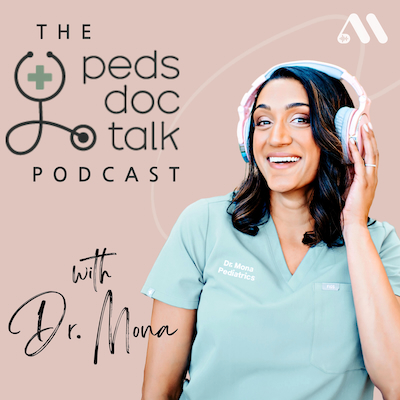

A podcast for parents regarding the health and wellness of their children.
In this episode, Dr. Mona is joined by Chelsea and Caitlin, the founders of Mama Psychologists, to unpack a crucial topic that many new mothers face: the difference between the “baby blues” and more serious perinatal mood disorders.
Together, they challenge the misconception that postpartum anxiety and depression always look like crying on the floor. Instead, they discuss the subtle, real-world signs—like the inability to hand your baby to a loved one without a racing heart or a mental to-do list that won’t shut off at 3:00 AM.
The “Baby Blues” vs. Postpartum Disorders: While the baby blues are an incredibly common reaction to the massive hormonal shifts right after birth, symptoms that persist, worsen, or significantly disrupt daily functioning may signal postpartum anxiety or depression.
Signs of Postpartum Depression: Key red flags include a persistent low mood, an inability to enjoy things you used to love, and struggling to meet basic needs like eating, drinking, or showering.
Signs of Postpartum Anxiety: This often manifests as racing thoughts, an intrusive “worst-case scenario” mindset, physical agitation (like a racing heart or tension), and difficulty turning off your mind to rest, even when the baby is sleeping.
The Timeline Myth: Postpartum mood disorders don’t always appear in the early weeks; they can frequently emerge four months postpartum or even later. Seeking support is vital, no matter how much time has passed since giving birth.
Breaking the Silence: Many moms suffer in silence due to guilt, shame, or fear of judgment. Finding a safe person to talk to is the first step toward healing because suffering quietly is not a badge of honor.
Want more? Listen to the full, original episode.
Our podcasts are also now on YouTube. If you prefer a video podcast with closed captioning, check us out there and subscribe to PedsDocTalk.
Get trusted pediatric advice, relatable parenting insights, and evidence-based tips delivered straight to your inbox—join thousands of parents who rely on the PDT newsletter to stay informed, supported, and confident. Join the newsletter!
And don’t forget to follow @pedsdoctalkpodcast on Instagram—our new space just for parents looking for real talk and real support.
We love the sponsors that make this show possible! You can always find all the special deals and codes for all our current sponsors on the PedsDocTalk Podcast Sponsorships page of the website.
00;00;00;02 – 00;00;21;06
Dr. Mona
Welcome to the follow up. I’m Doctor Mona, your pediatrician and online mom friend. And this is where we revisit a past episode of the show in less time than it takes to convince yourself you’re fine when you’re really not. And I know you’ve been there. Speaking of which, are you actually fine as a mom? Because here’s the thing.
00;00;21;11 – 00;00;38;23
Dr. Mona
I have seen a lot of new moms in my office and postpartum anxiety and depression doesn’t always look like what you’d expect. They don’t always look like crying on the floor. Sometimes they look like not being able to hand your baby to grandma without your heart racing. Sometimes they look like a to do list that won’t shut off at 3 a.m..
00;00;38;26 – 00;01;05;12
Dr. Mona
Sometimes it looks like being so consumed with worst case scenario that you can’t enjoy the moments you’re in. And for so many moms, they chalk it up to just being tired. Just being a worried mom. Just adjusting. But when does just adjusting become something more? That’s exactly what this episode is about. I sat down with Chelsea and Caitlin, the founders of Mama Psychologists, and we get into the real difference between the postpartum blues and postpartum anxiety and depression.
00;01;05;16 – 00;01;30;06
Dr. Mona
What the signs actually look like, and how to know when it’s time to get support. Because suffering quietly is not a badge of honor, and you deserve to actually feel like yourself again. Download this episode, share it with a new mom in your life, and tag at the PedsDocTalk podcast, PedsDocTalk and Mama Psychologist because someone in your circle needs to hear this one.
00;01;30;09 – 00;01;31;02
Dr. Mona
I get a lot.
00;01;31;02 – 00;02;01;09
Dr. Mona
Of women coming into my office who don’t kind of know the balance of, is this just normal motherhood I’m supposed to be experiencing, especially that postpartum period? Or is this actually something I need to see someone for, like postpartum anxiety or depression? So having this kind of open discussion about when is it? Where is that balance? Maybe some criteria on what you’re looking for, to kind of say, hey, look, it’s time that we take the next step and see a professional, that’s trained in this to help these moms.
00;02;01;11 – 00;02;17;16
Chelsea & Caitlin
Yes, absolutely. So one thing that we definitely look for is like, where is the person in the perinatal period, right. How far along are they? What are their symptoms like? All those kind of things. But when we’re looking at kind of that initial postpartum period, we look at that baby blues, right? That kind of colloquial term that we’ve all heard.
00;02;17;19 – 00;02;50;26
Chelsea & Caitlin
But I argue that most parents or most moms would go through grade year more. We’d be, you’re exhausted. Your hormones are changing, right? There’s a lot of change just happening really, really fast, not only in your environment. Obviously, taking home a new baby, but also within your body. And so we want to take that into consideration. So if it’s in the initial stages of giving birth, then we would probably just continue to monitor at that point, if it was somebody sitting in our office, right, we’d say, okay, you’re not feeling quite like yourself, but let’s see kind of what happens here as we progress later into the postpartum period.
00;02;50;28 – 00;03;20;03
Chelsea & Caitlin
So there’s a couple big things that we look for. So obviously with postpartum anxiety and postpartum depression, what are your symptoms. And I’ll go into that in a little bit. But what are your symptoms. And you know how significant are they impacting your day to day life. Right. Like are they preventing you from getting out of the house from doing things you normally enjoy, from interacting with people like how isolated and how impactful is one of the really key things that we want to look for, and also the intensity of the symptoms.
00;03;20;03 – 00;03;35;27
Chelsea & Caitlin
So are your symptoms improving, staying the same or getting worse? So if they’re staying the same or getting worse, we definitely want to investigate that further and see if that postpartum depression or anxiety or other perinatal mood disorders could be coming up. For that person.
00;03;35;29 – 00;03;57;29
Dr. Mona
And with baby blues, you know, which we do know is actually common. Do we have percentages on how many women experience that postpartum? And then also is that time frame, like you mentioned, that it’s common in those early weeks. Is that something that happens right away or is that something that develops more? So a week or two weeks after gets better by a month, like in terms of time frame to kind of look out for sure?
00;03;57;29 – 00;04;13;24
Chelsea & Caitlin
Well, there’s a kind of a misconception in terms of time frame. So a lot of people say like, oh, I’m four months postpartum, I’m out of the woods, right? I’m not going to have a postpartum perinatal mood disorder. And often that’s actually not the case. They actually come out later. So we look at like four months and beyond.
00;04;13;27 – 00;04;33;18
Chelsea & Caitlin
And when we look at like the diagnostic criteria, I guess to get a little like science and nerdy for a second, we really want to see, like within the first year is kind of the cutoff for when this would be, like diagnosable. However, we argue that, you know, you could be impacted by these symptoms in the postpartum period and they could go past the one year, right?
00;04;33;24 – 00;04;51;01
Chelsea & Caitlin
If there’s no treatment or if you’re still struggling. Right. We often have, people on our social media that will contact us to be like, am I have a two year old? And I still feel this way. And it’s like, it doesn’t matter if you’re past that one year, if you need that support, it’s really important to still reach out and get that.
00;04;51;03 – 00;05;11;09
Chelsea & Caitlin
In terms of statistics, when you look at like baby blues, I don’t know a specific percentage, but it would be upwards of most moms that would be giving birth because of that hormonal shift. Right. You’re looking at that really big change. I think I’ve read somewhere that it’s like the biggest hormonal shift you’ll ever experience in a short period of time because of giving birth.
00;05;11;09 – 00;05;20;09
Chelsea & Caitlin
The placenta is gone. All of your hormones are shifting, you know, with breastfeeding and lactating, all of those things. There’s just so much happening in the body in a short period of time.
00;05;20;11 – 00;05;36;22
Dr. Mona
If we can like chat about the symptoms overall, like for postpartum depression and postpartum anxiety and how they may differ from just mothers saying, well, this is what it’s supposed to be. This is sleep deprivation. When is it really something that, hey, this is something that we need to evaluate in terms of the symptoms.
00;05;36;25 – 00;05;56;08
Chelsea & Caitlin
Yeah. Of course. So when we’re looking at postpartum depression what we’re looking at is kind of low mood. We’re looking at you know, how are they doing in terms of activities like are you able to still enjoy things that you normally enjoyed or not. Also, of course, how you’re doing from like a general basic needs kind of standpoint, right.
00;05;56;08 – 00;06;14;28
Chelsea & Caitlin
Like are you able to shower, are you able to eat, drink, you know, those kind of things. And then this is one of the most annoying questions to ask a new parent. But you know, when we’re looking at sleep, we want to are you able to rest when you can’t. Right. So not necessarily that you’re sleeping, is great overall because you have a newborn.
00;06;14;28 – 00;06;32;03
Chelsea & Caitlin
But we really want to know, like, you know, somebody has the baby. Are you able to, you know, try to rest? Is your mind able to slow down? Are you able to get some stretches of sleep when the baby’s sleeping like those kind of things. So we really want to pay attention to that as well. And when we’re looking at postpartum anxiety, we’re looking at similar things.
00;06;32;03 – 00;06;51;06
Chelsea & Caitlin
However we’re looking at the treatment thoughts. So how how often that’s coming up, how intrusive thoughts in terms of like again, delaying you from doing things in your day to day life or preventing you from enjoying things, preventing you from going out, like kind of like Caitlin was talking about. We’re also looking at, you know, racing thoughts as well.
00;06;51;06 – 00;07;11;27
Chelsea & Caitlin
So not necessarily intrusive, but just really difficult time and slowing your thoughts and your mind down. Right. It’s like that constant to do list that continues to run in your head that you can’t really turn off or slow down. It’s also the idea that you know, your body can feel really agitated when you’re anxious. So, you know, are you noticing some tension in your body?
00;07;11;27 – 00;07;31;19
Chelsea & Caitlin
Are you noticing that you kind of feel like your heart’s racing or, you know, trying to take a deep breath feels impossible most of the time, right? Looking at those different things is what we be looking for. And so sometimes that can just be some normative stuff, right, that we’ve been talking about. It can be, you know, you’re a new mom, you’re feeling a little bit more anxious than normal trying to navigate parenthood.
00;07;31;24 – 00;07;42;25
Chelsea & Caitlin
So that’s where those come at that criteria of, you know, how intrusive it is on your day to day life and how intense the symptoms are really becomes important in kind of differentiating that.
00;07;42;28 – 00;07;53;13
Dr. Mona
And clarifying for anyone who’s listening who may not be familiar, you could have postpartum anxiety on its own. You could have postpartum depression on its own. But you can also have a mixture of both, right?
00;07;53;15 – 00;07;54;20
Chelsea & Caitlin
Yes, yes.
00;07;54;23 – 00;08;19;20
Dr. Mona
And so kind of looking at the symptoms that you all described is, is very important. Like, sometimes I have a lot of moms who are so against people helping their child because they feel like they have to do it all. Do you guys do you see a lot of that when you are dealing with postpartum anxiety? What is that balance where it’s like, hey, I want to be the one to take care of my kid versus is this actually postpartum anxiety?
00;08;19;20 – 00;08;21;19
Dr. Mona
If that makes sense.
00;08;21;21 – 00;08;39;07
Chelsea & Caitlin
Yeah. And that can you know what like you want to be the one to to be there to teach you to to do the things right. But can you, you know what. Leave and be like okay. You know what. They’re good with grandma. They’re good with dad. I’m going to go have a shower or take a bath.
00;08;39;09 – 00;09;00;29
Chelsea & Caitlin
Or do you find it difficult and you’re consumed with, oh my gosh, does he know that he needs to warm up the milk? Oh my gosh, is he, like, watching him? Is she going to roll. So all of those like worst case scenario thoughts like running through your mind when when they’re with that other a parent or a caregiver.
00;09;01;02 – 00;09;33;28
Dr. Mona
And that can feel so hard. And I again, I’m really happy that y’all are joining me for this episode, the other episode that we recorded, because I just feel like a lot of women deal with these things, like what you mentioned, like true postpartum anxiety or true depression, and don’t realize it until months after. In your experience, in your professional experience, do you feel like you have encountered women who have been sort of dealing with this for months on end and then finally realize that they need to see someone, or, and then they were like, well, I’ve probably been dealing with this for over six months or a year.
00;09;34;01 – 00;09;49;18
Chelsea & Caitlin
Absolutely. It’s really important to try to find somebody you feel safe talking about these things. Right. We get a lot of moms that are be like I was so scared to share this. I’m so scared to talk about it because I thought, you know, people are going to think I’m a bad mom or that I didn’t know they don’t love my baby.
00;09;49;18 – 00;10;06;25
Chelsea & Caitlin
And then they kind of just suffer again in that silence because they’re so consumed by, you know, those feelings of guilt and shame. So if there’s somebody you can reach out to that you feel safe with, that you can talk to that’s really important just to get the conversation going. Maybe they can support you in making a doctor’s appointment.
00;10;06;25 – 00;10;18;04
Chelsea & Caitlin
Maybe they can help you look up, you know, therapists in your area or whatever that might be, but just have somebody that you feel that you can start those conversations with.
00;10;18;06 – 00;10;39;15
Dr. Mona
And that’s your follow up. Just a small dose of the real relatable and eye opening conversations we love to have here. If you smiled, nodded, or had an moment, go ahead and download, follow and share this episode with a friend. Let’s grow this village together for more everyday parenting wins and real talk. Hang out with us on Instagram at the PedsDocTalk podcast.
00;10;39;23 – 00;10;55;05
Dr. Mona
Want more? Dive into the full episode and more at PedsDocTalk.com. Because parenting is better with support and remember, consistency is key. Humor is medicine and follow ups are everything. I’m Doctor Mona. See you next time for your next dose.
Please note that our transcript may not exactly match the final audio, as minor edits or adjustments could be made during production.
Need help? We’ve got you covered.
All information presented on this blog, my Instagram, and my podcast is for educational purposes and should not be taken as personal medical advice. These platforms are to educate and should not replace the medical judgment of a licensed healthcare provider who is evaluating a patient.
It is the responsibility of the guardian to seek appropriate medical attention when they are concerned about their child.
All opinions are my own and do not reflect the opinions of my employer or hospitals I may be affiliated with.