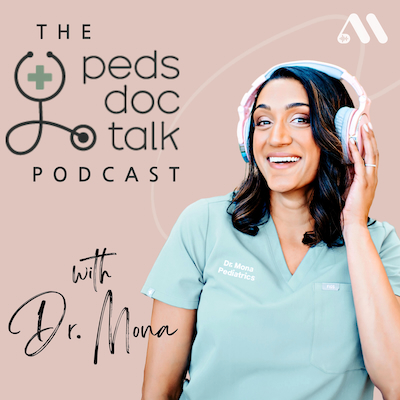

A podcast for parents regarding the health and wellness of their children.
On this episode of Monday Mornings with Dr. Mona, a mother of a 1 year old calls in to ask bout the impact her postpartum depression can have on the development of her child.
I discuss why maternal (and parental mental) health matters and what we see for the developmental impact for kids.
A few resources:
00;00;01;04 – 00;00;07;15
Dr. Mona
Welcome to Monday Mornings with Doctor Mona, where each week I answer your questions.
00;00;07;17 – 00;00;42;16
Mom
Hi Doctor Mona, I love listening to your podcast. My name is Katie and I have a one year old and my question is, how is mine? Battle with postpartum depression affect going to affect him and is it affecting him long term? I, have sought treatment for it. I am on medication, I see a therapist, and I am doing the best that I can, but is there anything that I am doing or going through that’s going to pass on?
00;00;42;18 – 00;00;46;13
Mom
To him or through him emotionally? Thank you so much.
00;00;46;19 – 00;01;05;02
Dr. Mona
Hi, Katie, thank you so much for this question. This is such an important topic to discuss. And one I’m very passionate about, not only in my professional career, but it affected me personally. I myself had a traumatic delivery with my son, Ryan, who’s now almost two and a half at the time of this recording, saw a therapist after Ryan’s delivery.
00;01;05;02 – 00;01;27;28
Dr. Mona
And then I also developed severe depression and anxiety eight months postpartum. My depression was actually very situational, in that it was directly related to going back to in-person work in a pandemic, at a job that caused me a lot of stress and anxiety. So all of that combined, having a child at home, it was extremely difficult for me.
00;01;28;00 – 00;01;49;14
Dr. Mona
I actually discussed the stigma behind maternal mental health in a podcast episode I recorded with Doctor Lakshman, who is a perinatal psychiatrist. This is episode 39. It’s okay to not be okay. I share a little bit about my story. We talk about normalizing maternal mental health issues such as depression and anxiety, and how to know when it’s time to get help and so much more.
00;01;49;14 – 00;02;08;14
Dr. Mona
So make sure you take a listen to that. First off, there is just a lot of stigma surrounding maternal mental health and even paternal mental health. I mean, that’s actually something that’s not even talked about a lot. And I’m going to have hopefully a father come on to talk about his perspective or a non birthing partner because it’s something we don’t recognize but it’s a reality.
00;02;08;16 – 00;02;29;06
Dr. Mona
I first want to really applaud you for recognizing you needed professional help and getting it. That is honestly the dream I have for moms, and kind of why I started this podcast to normalize the feelings we have. I do the finding Joy episodes where I talk about mindset shift, but I also have to admit that it’s not always just a mindset shift.
00;02;29;06 – 00;02;51;12
Dr. Mona
It’s also something chemical, and it’s something that we need formal therapy for. Many times, many women suffer in silence or don’t have access to resources they need, which is imperative before I get into the effect this can have on children, I first want you to recognize that I want you to get help for depression and anxiety because it’s important for you.
00;02;51;15 – 00;03;10;22
Dr. Mona
Yes, coping will help your family, but it starts with how this will make you feel. I for one, do not love how depression and anxiety made me feel. Eight months postpartum I would wake up with a racing heart rate. The moment I woke up, I was just palpitations and a feeling of dread. I would wake up feeling sad.
00;03;10;22 – 00;03;30;23
Dr. Mona
I would be crying the moment I woke up just feeling like dejected with the world. And I also would be pulling over on my way to work with panic attacks. This wasn’t me. And so the first thing I want to go over is that if you’re listening to this and you’re saying to yourself, I’m feeling things that are not me, this is not what I normally feel.
00;03;30;23 – 00;03;49;08
Dr. Mona
This is not how I normally act. This is something that you’re really going to want to dive into and have some self insight into, into learning if I need to get help or if it’s something that you can do with mindset shift, things like that. But it’s so important to remember that it’s okay to not be okay. And that is the first step.
00;03;49;08 – 00;04;06;09
Dr. Mona
So thank you so much for recognizing that. And if you’re listening to this and you’re like, well, things are okay. Things are not, I really want you to say to yourself, is this something that I can get help for now before it gets worse, before there’s an event in your life or something that happens that makes you go into that spiral?
00;04;06;09 – 00;04;26;23
Dr. Mona
I want you to take control over all of your life, and that includes your mental health. Now let’s discuss our children. So a caregiver who is physically not present is obviously one thing. And we know that quality of time is so much more important than quantity of time. And that is where this postpartum depression can come into play.
00;04;26;23 – 00;04;46;14
Dr. Mona
Because when you have postpartum depression, there is a higher likelihood that you’re mentally not present. You physically are there, but your lack of mental presence, you know, your mind is just consumed with other thoughts, which is part of the depression and anxiety. This can impact a child. There are a few studies I’m going to be linking in the show notes.
00;04;46;17 – 00;05;15;19
Dr. Mona
However, I think there’s a lot of fear surrounding this topic, which is probably why you’re calling in. You know, you’re concerned about the outcome of your child, and I want us to look at the big picture here. One of the biggest concerns we see with the primary caregiver, where there is no other caregiver involved. And if that primary caregiver has untreated depression, there can be a lack of social and emotional reciprocity with that child and delay in developmental milestones, particularly language milestones.
00;05;15;19 – 00;05;43;21
Dr. Mona
And I’m going to get into that. Some studies do show that the infant of a depressed mother is at higher risk of insecure attachment dysregulation, poor self-control, difficulties in cognitive functioning. However, I want to be clear that this is in a situation where there is constant toxic stress, meaning it’s more than just depression. It’s a constant state of dysregulation in the home, not something I imagine is happening in your home.
00;05;43;21 – 00;06;09;09
Dr. Mona
And I want to reassure you, toxic stress are things like poverty, extreme poverty, marital conflict, which obviously is a lot of yelling and fighting and physical or emotional abuse in the caregivers. And this is something that is more than just depression. Obviously, depression is so important to look at, but toxic stress environments is what can have the poor outcomes for children.
00;06;09;11 – 00;06;41;05
Dr. Mona
So what is that reciprocity? I’m speaking about earlier when I said that when you’re depressed, you can lack that reciprocity for social and emotional development, language development and child development is based in co regulation. And that reciprocity. So in the first few years of life a child’s brain develops a million new neural connections every second. And these connections are influenced by many environmental factors, most significantly the child adult interaction or the child and primary caregiver interaction.
00;06;41;07 – 00;06;59;03
Dr. Mona
This is the give and take interaction between infants and adults. So for example, in the newborn period, you know your baby will start to coo around one month, usually two months. A little later. And when your baby starts to coo, you’re supposed to coo back, right? This is a social and emotional bond, but it’s also language development, right?
00;06;59;03 – 00;07;22;08
Dr. Mona
They’re kind of talking to you in their own baby language, and you’re talking back that reciprocity is really important for that bond and language development. This back and forth interaction provides much needed stimuli for the babies developing brain. So they learn about they’re doing something. My caregiver is responding. So again it builds that social emotional development. But it also builds that language reciprocity.
00;07;22;08 – 00;07;42;15
Dr. Mona
That’s so needed. And it really helps in creating a healthy bond between caregiver and child. Now how can postpartum depression interfere with this reciprocity of a relationship that we love? So having been in this state, you know, Ryan was eight months old, so he wasn’t in that newborn period. But I had little desire to do the things I used to love.
00;07;42;15 – 00;07;59;07
Dr. Mona
And that included seeing my child. I mean, I’m being very honest. I had a really hard time smiling and being in front of him, and I just felt like I wasn’t myself and I didn’t want him to see me like that. And I just felt like I didn’t want that energy around him either. That was a personal feeling that I had.
00;07;59;09 – 00;08;20;05
Dr. Mona
And when you have depression, you could have very little desire to do the things that we need to do as caregivers, right? Play time, full time, etc. so you can somewhat feel like a ghost. And those moments of reciprocity can be lost. So when you are feeling you’re not yourself and you’re just feeling kind of like you’re physically there but not emotionally there, you’re not going to interact with your baby as much, right?
00;08;20;05 – 00;08;46;18
Dr. Mona
You’re not going to have that reciprocity of cooing when they laugh. You may not laugh back. You’re not going to feel that sort of back and forth connection that is important for child development. And that is why it’s so important that we seek the help that we need so that we can be more mentally present. I see this also in breastfeeding mothers, you know, who are depressed with the breastfeeding process, whether it’s not going as they expected, their pumping and pumping is just not working for them.
00;08;46;18 – 00;09;08;19
Dr. Mona
And again, every mother is different. I see it, their affect is off. They’re not engaged. They’re not bonding. They’re depressed with the entire experience. And because of that, they’re not having that reciprocity with social emotional development and language development. Obviously, the cooing, the squealing, the laughing, the the raspberries, all of that. And stopping breastfeeding is what works for them.
00;09;08;21 – 00;09;36;00
Dr. Mona
And that is why I preach this so much that as mothers, all parents. But I’m speaking mom to mom. If you’re a mom as well, that you have to look at what is bringing you peace and what is giving you joy as a mother, and that is what the most important thing is. Obviously, we’re taking into consideration our child’s development, but a happy mom or caregiver, a happy primary caregiver, if you will, will mean that the baby will also be happy or content and remember happiness.
00;09;36;00 – 00;09;53;17
Dr. Mona
How I describe it is not a feeling of constantly feeling happy. And you can’t have any moment of sadness. I’m talking about that feeling of life is okay, life is good. We’re going to have some ups and downs, baby mommy, whoever, but we are going to handle it. In your situation, I want to reassure you of a few things.
00;09;53;19 – 00;10;12;05
Dr. Mona
One, you recognize this and are getting help. And again, I want to really applaud you for that. It takes a lot of courage and vulnerability to recognize that you look, I need help and I think that’s fantastic. Number two, your child is not in a toxic stress environment, so I don’t feel like you’re going to see any of these long term impacts at all.
00;10;12;07 – 00;10;39;01
Dr. Mona
Babies consistently deprived of that social reciprocity, language reciprocity can experience levels of stress that are constant to the point that affects their developing brain. But what you’re going through is not toxic stress. Number three is that other caregivers matter, too. When I went through that depression, I relied heavily on my husband and nanny to help me because I just couldn’t even look at Ryan because I wasn’t myself.
00;10;39;04 – 00;11;03;00
Dr. Mona
It was a horrible feeling. But other caregivers provided that love and social reciprocity and emotional reciprocity for my child. Yes, while I was managing that depression, he did not get it fully from me. And that’s okay. He was able to get it from people who were emotionally able to give it, and that actually gave me peace. So I utilized our nanny more than I ever did.
00;11;03;00 – 00;11;23;14
Dr. Mona
We had her coming a lot more hours, and I normally did. And I, you know, didn’t talk to her about what was happening. But I, you know, I said I’m very appreciative of this. Sometimes we don’t have that help. Right? Sometimes, especially in the newborn phase when it’s really tough, you may have a partner that’s working and not a home because they don’t have, paternity leave or a non birthing partner leave.
00;11;23;16 – 00;11;43;29
Dr. Mona
Or you may be single and it’s so important to recognize who can I count on to help me in these situations. So rest assured your child will thrive. But yes, you need to thrive also. And that is why getting the help is so key. And I don’t want you to look at this as you need to have an endpoint of.
00;11;44;04 – 00;12;12;20
Dr. Mona
I need to be in a happy state. I need to be off of meds, I need to be X, Y, and Z. The goal is for you to be in a state where you feel at peace with the ups and downs of motherhood, and that is what I’m actually trying to do with the finding Joy series. I’m trying to help you realize that even if you’re going through really hard times, which we all do, and I’ve been there, that how can we get to a state where we are going to say, I am in therapy for depression, I am on meds, I am doing this, that or the other, but I am at peace with
00;12;12;20 – 00;12;43;07
Dr. Mona
where I am right now. That is the most important thing that we can bring our selves, because that is what’s going to bring joy to our family. A taking care of mama is vital to a child, so you can be emotionally present. Motherhood is so hard and I think we can all attest to this. It is really hard, but it is harder when we’re dealing with depression, anxiety that is not going manage meaning whether that’s through therapy, mindset shift medicine, all of that matters.
00;12;43;09 – 00;13;01;15
Dr. Mona
We’re just not able to be present. If you have that depression. So I encourage everyone listening who feels like a ghost of a person who feels that maybe I’m just not there and you’ll know. You’ll say to yourself, this isn’t me. Before I became a mom, this wasn’t me. And that’s what I told my husband. I’m like, this isn’t me.
00;13;01;22 – 00;13;27;28
Dr. Mona
For me to feel sad every time I wake up, for me to have palpitations. This wasn’t me. You need to get that help if you need it. And again, remember, this is not only for the benefit of your child that they have a more present caregiver emotionally present. This is for you. This is because I know from personal experience that when depression and anxiety, especially in motherhood, gets so overwhelming, it does not make me feel good.
00;13;28;01 – 00;13;49;19
Dr. Mona
And I’m doing this not only for my child, but for myself as well. And that is the mantra of motherhood we focus so much on, well, what is the outcome for my child? Although that is such an important conversation and I hope you got the message that what you’re going through is not going to lead to toxic stress in your child’s going to have great outcomes, because you’re working on stuff and you have other caregivers who are giving them what they need.
00;13;49;19 – 00;14;11;23
Dr. Mona
If you’re not in the space to give it. And even if you don’t have other caregivers, you are working on yourself and you are recognizing that. I understand that these are my capabilities. This is my strengths, my weaknesses, and that is what’s so important. But that matters. But what matters more is that you are looking out for the well-being of yourself so that you can be the best person you can be in life.
00;14;11;25 – 00;14;28;23
Dr. Mona
And the best mother you can be for your child. Thank you for tuning in today. If you find this series helpful or any of my content helpful, please make sure to share it on your social media channels because that is how other people can find this resource. So thank you so much for joining us and I will talk to you next week.
Please note that our transcript may not exactly match the final audio, as minor edits or adjustments could be made during production.
Need help? We’ve got you covered.
All information presented on this blog, my Instagram, and my podcast is for educational purposes and should not be taken as personal medical advice. These platforms are to educate and should not replace the medical judgment of a licensed healthcare provider who is evaluating a patient.
It is the responsibility of the guardian to seek appropriate medical attention when they are concerned about their child.
All opinions are my own and do not reflect the opinions of my employer or hospitals I may be affiliated with.